


Cylinder Head seals combustion chamber, houses valves & spark plugs, forms coolant passages, wit...
Content
Aluminum die casting molds are permanent steel tooling used to inject molten aluminum alloy under high pressure—typically 1,500 to 25,000 psi—into a precisely machined cavity, producing net-shape or near-net-shape aluminum die castings with tight dimensional tolerances, smooth surfaces, and excellent mechanical properties. The mold is not a consumable; a well-maintained die casting mold can produce 100,000 to over 500,000 shots before requiring major refurbishment, making tooling investment the dominant upfront cost in an aluminum die casting program.
The relationship between mold quality and casting quality is inseparable. Gate location, cooling channel design, venting layout, and surface finish of the cavity directly determine whether aluminum die castings meet porosity limits, dimensional accuracy requirements, and cosmetic standards. Understanding both the mold and the castings it produces is essential for engineers, buyers, and quality teams working in automotive, electronics, aerospace, and industrial equipment manufacturing.
A die casting mold—also called a die or tool—consists of two primary halves mounted to a die casting machine: the fixed half (cover die, or stationary die) and the ejector half (moving die). Together they form the cavity that defines the shape of the aluminum die casting.
Die casting molds for aluminum operate in one of the most demanding thermal environments in manufacturing. Each shot cycle, the cavity surface is heated from the mold temperature (typically 180–250°C) to the molten aluminum contact temperature (~680°C), then cooled back—a thermal delta of 400–500°C in under one second. This thermal fatigue, combined with erosion from high-velocity metal and corrosion from aluminum alloy chemistry, makes steel selection critical.
| Steel Grade | Working Hardness (HRC) | Thermal Fatigue Resistance | Typical Mold Life (shots) | Primary Use |
|---|---|---|---|---|
| H13 (AISI) | 44–48 | Good | 100,000–300,000 | Standard cavity inserts |
| Premium H13 (ESR/VAR) | 44–48 | Very Good | 200,000–500,000+ | High-volume automotive dies |
| DIN 1.2344 (H11 equiv.) | 42–46 | Good | 100,000–250,000 | European tooling standard |
| Dievar / Orvar Supreme | 44–50 | Excellent | 300,000–600,000 | Critical inserts, gate areas |
| Beryllium copper (BeCu) | 38–42 HRC | Moderate | 50,000–150,000 | Cores, inserts needing rapid cooling |
H13 tool steel remains the industry standard for aluminum die casting molds globally. The shift to vacuum arc remelt (VAR) or electroslag remelt (ESR) premium H13 is now standard practice for automotive programs targeting 300,000+ shot life, as inclusion content in premium-grade material is reduced by up to 60% versus conventional H13.
The manufacturing of a die casting mold typically takes 8 to 20 weeks for a production-intent tool, depending on complexity and the number of slides. The process follows a defined sequence:
The choice of aluminum alloy affects casting fluidity, mechanical properties, corrosion resistance, and machinability. Most aluminum die castings use alloys from the Al-Si family due to their excellent castability—silicon lowers the melting point and improves fluidity, reducing misruns and cold shuts.
| Alloy (NADCA/ISO) | Si Content (%) | UTS (MPa) | Elongation (%) | Typical Application |
|---|---|---|---|---|
| A380 (ADC10) | 7.5–9.5 | 324 | 3.5 | General purpose, housings, brackets |
| A383 (ADC12) | 9.5–11.5 | 310 | 3.5 | Complex thin-wall parts, electronics |
| A360 | 9.0–10.0 | 317 | 3.5 | Pressure-tight parts, marine |
| A413 | 11.0–13.0 | 296 | 2.5 | Very thin walls, hydraulic cylinders |
| Silafont-36 (AlSi10MnMg) | 9.5–11.5 | 320 (T7: 260) | 10–14 (T7) | Structural automotive (crash-relevant) |
| Aural-2 / Castasil-37 | 9.0–11.0 | 280–320 | 10–15 | EV battery trays, structural nodes |
A380 accounts for roughly 50–60% of all North American aluminum die casting production by volume due to its balanced combination of castability, strength, and cost. The trend toward high-ductility alloys like Silafont-36 and Aural-2 is accelerating rapidly, driven by electric vehicle structural castings that require elongation above 8–10% in the as-cast or heat-treated condition to absorb crash energy.
Aluminum die castings are produced exclusively by the high-pressure die casting (HPDC) process in commercial production. Understanding the process sequence is essential for designing castings that the mold can reliably produce.
The injection sequence has three phases. In Phase 1 (slow shot), the plunger moves slowly (0.1–0.5 m/s) to push molten metal to the gate without creating turbulence in the shot sleeve. In Phase 2 (fast shot), the plunger accelerates to 2–6 m/s to fill the cavity in 10–80 milliseconds. In Phase 3 (intensification), pressure spikes to 500–1,200 bar to compensate for solidification shrinkage, reducing porosity in critical sections.
A complete HPDC cycle—closing, injecting, solidifying, opening, ejecting, and spraying—typically takes 30 to 90 seconds for small-to-medium aluminum castings. A 400-ton machine producing a 1.2 kg automotive bracket can achieve 60–80 shots per hour, translating to 1,440–1,920 castings per day on a single shift. Cooling channel design directly controls the solidification portion of cycle time, which typically represents 40–60% of total cycle time.
Standard HPDC traps air during fill, resulting in gas porosity levels of 0.5–3% by volume, which prevents heat treatment (T5/T6) of most standard castings. Vacuum-assisted HPDC (VHPDC), which evacuates the cavity to below 50 mbar before injection, reduces porosity to below 0.1%, enabling T6 heat treatment and achieving elongation values of 8–14%—critical for structural EV components.
Casting defects almost always trace back to mold design decisions made weeks or months before the first shot. The following parameters have the greatest influence on aluminum die casting quality:
Gate cross-sectional area controls metal velocity at the gate entrance. NADCA guidelines recommend gate velocities of 25–50 m/s for most aluminum alloys. Below 25 m/s, the metal stream may not atomize properly, increasing cold shuts. Above 55 m/s, erosion of the gate and adjacent cavity surface accelerates rapidly—a common cause of premature mold failure in high-production dies.
Draft angles allow the casting to release cleanly. Standard recommendations are 1–3° on external walls and 2–5° on internal walls (cores). Textured surfaces require additional draft—typically 1° per 0.025 mm of texture depth. Insufficient draft causes drag marks, torn surfaces, and premature ejector pin wear.
Minimum recommended wall thickness for aluminum die castings is 1.0–1.5 mm for small parts and 1.5–2.5 mm for larger structural castings. Walls below 1 mm are feasible with vacuum-assisted processes and optimized gate design, but require significantly tighter mold tolerances and higher injection velocities.
Conventional straight-drilled cooling channels cannot follow complex cavity geometry. Conformal cooling inserts produced by metal additive manufacturing (DMLS/SLM) place cooling channels within 5–15 mm of the cavity wall in any geometry, reducing hot spot temperatures by 30–60°C and cycle time by 15–30% in complex cavity regions. Adoption of conformal cooling is growing rapidly in automotive die casting.
Aluminum die castings offer tighter as-cast tolerances than sand casting or permanent mold casting, often eliminating secondary machining on non-critical features. NADCA Product Standards define achievable tolerances as follows:
| Dimension Range (mm) | Standard Tolerance (±mm) | Precision Tolerance (±mm) | Notes |
|---|---|---|---|
| Up to 25 | ±0.13 | ±0.08 | Within one die half |
| 25–63 | ±0.18 | ±0.10 | Within one die half |
| 63–160 | ±0.25 | ±0.15 | Within one die half |
| 160–400 | ±0.36 | ±0.20 | Within one die half |
| Across parting line (any) | Add ±0.25 | Add ±0.13 | Parting line allowance |
Features crossing the parting line (the interface between the two die halves) carry additional tolerance because die closure variation, thermal expansion, and wear all contribute to variation at this interface. For tighter cross-parting tolerances, secondary machining is typically required.
Aluminum die casting defects fall into two broad categories: those driven by process parameters (shot velocity, metal temperature, die temperature) and those driven by mold design. The following defects are predominantly mold-related:
A die casting mold represents a capital investment of $50,000 to over $500,000 USD depending on size and complexity. Protecting that investment through disciplined maintenance directly affects per-part cost over the mold's life.
Bringing a cold die directly to operating temperature with live aluminum shots is a leading cause of premature heat checking. Best practice requires preheating the die to 150–200°C using a gas or electric die heater before the first shot, followed by a 20–30 shot warm-up sequence with reduced injection pressure. This thermal conditioning protocol alone can extend cavity insert life by 30–50% in high-volume production.
Since Tesla introduced Giga Press technology in 2020, the die casting industry has experienced a paradigm shift toward extremely large, single-piece structural castings that replace dozens of stamped and welded components.
Mega-casting (also called giga-casting) uses machines with clamping forces of 6,000 to 16,000 tons, producing rear underbody or front structure castings weighing 40–80 kg in a single shot. The molds for these castings are correspondingly enormous—die sets can weigh 60–100 metric tons and cost $8–20 million USD to develop and produce.
Key technical challenges of mega-casting molds include:
Multiple OEMs including Volvo, General Motors, Toyota, and NIO have publicly committed to mega-casting programs, confirming that this manufacturing approach is moving from Tesla-exclusive innovation to industry standard.

Cylinder Head seals combustion chamber, houses valves & spark plugs, forms coolant passages, wit...

The camshaft bracket cover secures the camshaft position, seals oil channels to prevent leaks, block...
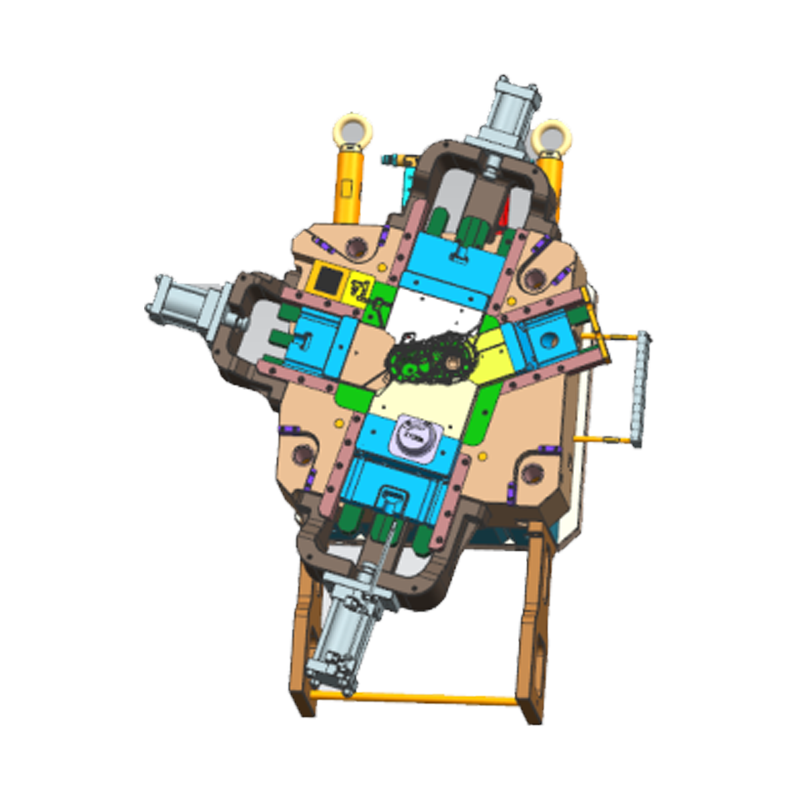
Aluminum die-casting gearbox mold the most critical requirements: 1. Material properties require hig...

Die casting transmission EM Side Housing mold is designed by JYD(Yunmai) for NIO transmission Rear H...

transmission rear Housing molds are foundational to the efficient and precise manufacturing of autom...
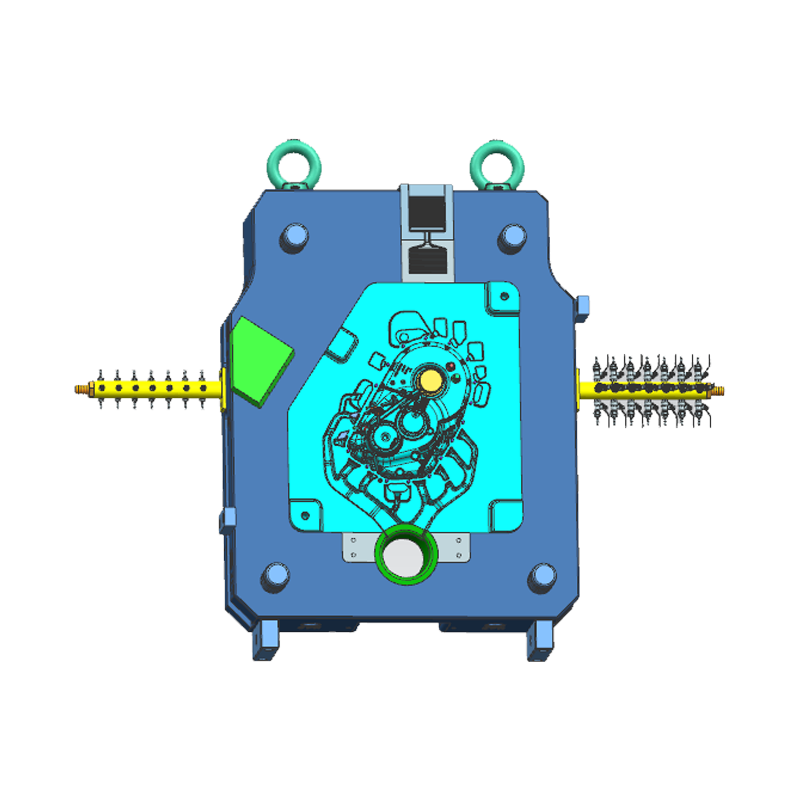
SERES transimission adopts complex cavity structure; high efficiency cooling system, the development...
Copyright © Ningbo Yunmai Precision Machinery Co., Ltd. All Rights Reserved
 OEM/ODM Die Casting/Cast Molds Manufacturers