


Cylinder Head seals combustion chamber, houses valves & spark plugs, forms coolant passages, wit...
Industry News
Home / News / Industry News / Aluminum Die Castings for Communication Components: Materials, Specifications, and Applications
Content
Aluminum die castings are the preferred manufacturing method for communication components — including RF shield covers, antenna housings, base station enclosures, and connector housings — because they deliver electromagnetic shielding, thermal management, and structural rigidity in a single seamless part. For most communication hardware, ADC12 aluminum alloy (JIS equivalent to A383) is the recommended material, offering thin-wall castability down to 0.6–1mm, thermal conductivity around 130 W/m·K, and dimensional tolerances as tight as ±0.05mm — precision that stamped metal or injection-molded plastic enclosures cannot consistently match.
This article explains why Communicational component Aluminum Die Castings fits communication applications, which alloy and process choices matter most, and how to specify a part that performs reliably in 5G, base station, and networking environments.
Communication equipment — 5G small cells, macro base stations, RF filters, routers, and switches — shares three demands that aluminum die casting satisfies better than alternative processes: electromagnetic compatibility, heat dissipation, and dimensional consistency across thousands of production units.
Aluminum is naturally conductive, so a die-cast enclosure acts as its own EMI/RFI shield without added conductive coatings. Because high-pressure die casting (HPDC) produces a seamless, one-piece structure rather than a welded or multi-part assembly, there are no seams for electromagnetic leakage to escape through — a critical requirement when a filter or RF module sits centimeters from an antenna operating in overlapping frequency bands.
Aluminum also conducts heat well. Pure aluminum reaches roughly 205 W/m·K thermal conductivity, and even die-casting alloys optimized for flow rather than pure conductivity, such as ADC12, still deliver approximately 130 W/m·K — enough to pull heat away from power amplifiers and RF modules through integrated fins cast directly into the housing, eliminating the need for a separate heat sink component.
Alloy selection determines whether a die-cast communication component meets its shielding, thermal, and cost targets simultaneously. Three alloys account for the overwhelming majority of communication die castings worldwide.
ADC12 accounts for the majority of communication-grade aluminum die castings, largely because its silicon content (9.6–12%) gives it superior fluidity, allowing it to fill thin, intricate mold cavities — such as antenna housing ribs or connector-port geometry — with fewer porosity defects than lower-silicon alloys. It also machines and taps cleanly for secondary operations like threaded mounting bosses, and its tensile strength in the as-cast condition typically falls between 210 and 260 MPa.
A380 is the North American equivalent to ADC12 and is chemically similar, but its higher copper content (3–4% versus ADC12's 1.9–3%) gives it slightly greater yield strength, making it the better choice for base station chassis or mounting brackets that carry structural load in addition to shielding duty.
Unlike ADC12 and A380, AlSi10Mg can undergo T6 heat treatment to significantly raise strength after casting, which makes it a fit for high-power RF amplifier enclosures where both thermal cycling resistance and mechanical strength matter. It costs more and is used more selectively than the other two alloys.
| Alloy | Thermal Conductivity | Tensile Strength | Best Fit |
| ADC12 | ~130 W/m·K | 210–260 MPa | Thin-wall RF shields, connector housings |
| A380 | Slightly higher than ADC12 | 240–310 MPa | Structural base station enclosures |
| AlSi10Mg | Comparable, heat-treatable | Improves substantially with T6 | High-power RF amplifier housings |
Communication components often mate with gaskets, seals, PCB mounts, or waveguide interfaces where a dimensional error of even a few hundredths of a millimeter can compromise shielding effectiveness or ingress protection. High-pressure die casting, paired with precision-machined mold cavities, routinely achieves dimensional tolerances of ±0.01mm to ±0.05mm, which is why it remains the dominant process for RF-critical parts rather than sand casting or plastic injection molding.
Uniform wall thickness matters as much as absolute tolerance. Inconsistent wall sections cool at different rates during casting, which can introduce warping or porosity that creates micro-gaps — and micro-gaps are exactly where electromagnetic interference leaks through an otherwise well-shielded enclosure. Specifying consistent wall thickness across a design, typically in the 0.6mm to 3mm range depending on part size, is one of the most cost-effective ways to protect shielding performance before the tool is even cut.
Outdoor communication equipment — macro base stations, small cells, rooftop antenna units — must survive rain, dust, temperature swings, and UV exposure for a service life often specified at 15 to 20 years. Aluminum die-cast enclosures are commonly rated to IP65 or higher, meaning they are fully dust-tight and protected against low-pressure water jets from any direction, a rating that plastic-seamed enclosures struggle to hold consistently over a long field life.
Surface treatment is what turns raw casting into a field-durable part. Common finishing options for communication housings include:
The component categories below make up most of the demand for aluminum die castings in the telecommunications sector, and each draws on a slightly different combination of the alloy's properties.
Before releasing a communication component to tooling, confirming the following points with the die caster reduces the risk of costly redesigns after the mold is cut.
| Specification Point | Why It Matters |
|---|---|
| Alloy grade (ADC12 / A380 / AlSi10Mg) | Determines thermal conductivity, strength, and cost balance |
| Wall thickness uniformity | Prevents warping and porosity that can break shielding continuity |
| Dimensional tolerance | Ensures proper gasket seating and mating with PCB or waveguide interfaces |
| IP rating target | Confirms the part meets dust/water ingress requirements for its deployment environment |
| Surface treatment | Balances corrosion protection, conductivity, and appearance requirements |
| Secondary machining needs | Identifies tapping, drilling, or CNC finishing required after casting |
Aluminum die casting carries a higher upfront tooling cost than plastic injection molding, but that gap narrows or reverses at volume because die-cast parts often eliminate the need for a separate metal shield or heat sink component — the housing does both jobs at once. Aluminum's strength-to-weight ratio also delivers 60–70% mass savings compared to steel enclosures of equivalent strength, which matters directly for shipping cost and installation labor on rooftop or tower-mounted equipment.
Aluminum is also fully and repeatedly recyclable without loss of material properties, which is increasingly relevant as network operators and equipment manufacturers set circular-economy sourcing targets. A die-cast aluminum enclosure at end of life can be remelted into new stock rather than discarded, unlike composite or painted plastic housings.

Cylinder Head seals combustion chamber, houses valves & spark plugs, forms coolant passages, wit...

The camshaft bracket cover secures the camshaft position, seals oil channels to prevent leaks, block...
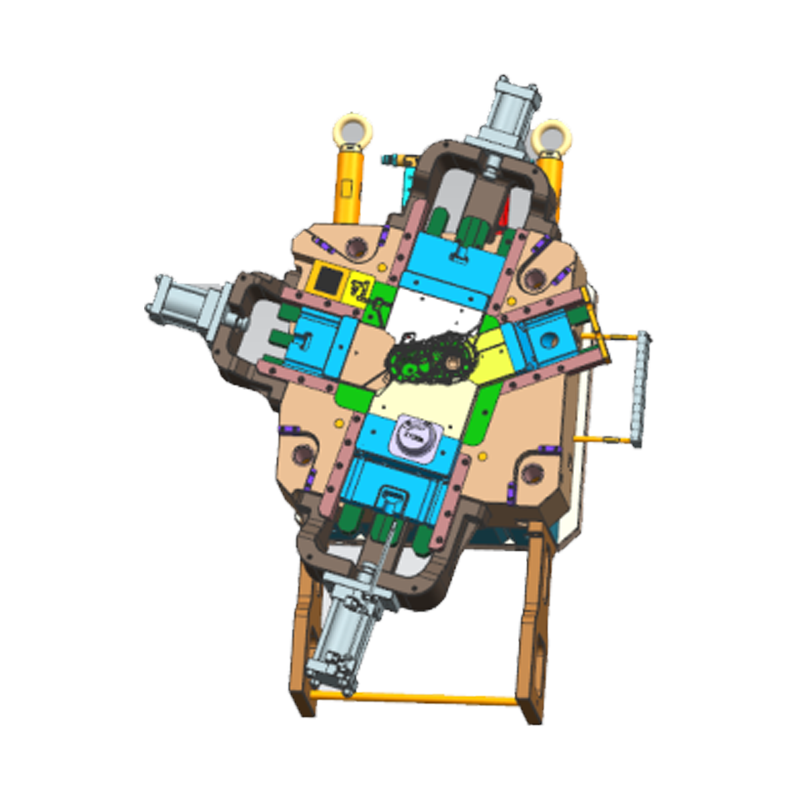
Aluminum die-casting gearbox mold the most critical requirements: 1. Material properties require hig...

Die casting transmission EM Side Housing mold is designed by JYD(Yunmai) for NIO transmission Rear H...

transmission rear Housing molds are foundational to the efficient and precise manufacturing of autom...
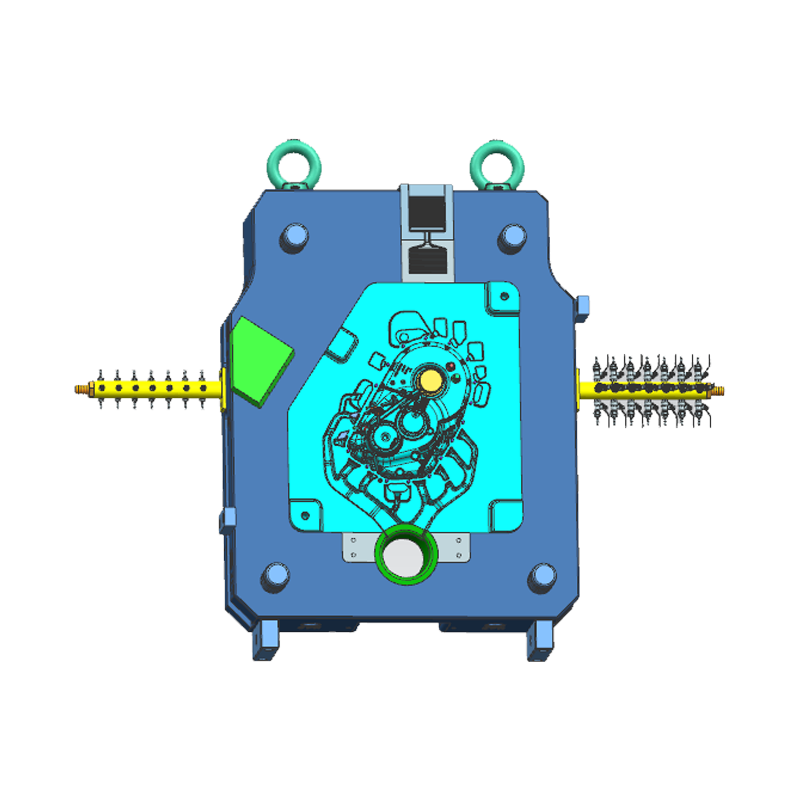
SERES transimission adopts complex cavity structure; high efficiency cooling system, the development...
Copyright © Ningbo Yunmai Precision Machinery Co., Ltd. All Rights Reserved
 OEM/ODM Die Casting/Cast Molds Manufacturers