


Cylinder Head seals combustion chamber, houses valves & spark plugs, forms coolant passages, wit...
Industry News
Home / News / Industry News / Electromechanical Aluminum Die Castings: The Engineering Guide to Shielding, Cooling, and Sourcing
Content
Electromechanical aluminum die castings are precision aluminum components — motor housings, connector shells, terminal boxes, and enclosures — produced by forcing molten aluminum alloy into a hardened steel die under high pressure, chosen specifically because cast aluminum combines electrical conductivity for EMI/RFI shielding with high thermal conductivity for heat dissipation in a single, seamless part.
If a part needs to house or protect an electrical or electromechanical assembly — a motor, a connector, a power module, a sensor — while also shielding it from interference and pulling heat away from it, die-cast aluminum is almost always the default engineering choice over plastic, sheet metal, or machined billet. The reason is structural: a single die-cast shell conducts electricity (blocking EMI/RFI) and conducts heat (acting as a passive heat sink) at the same time, something a molded plastic housing can only approximate with added coatings or fillers.
The sections below cover how these parts are actually produced, which alloys are specified for which duty, and what to check on a supplier's quality documentation before committing to tooling.
Not every aluminum die casting is electromechanical — the term specifically describes castings engineered to sit at the boundary between a mechanical structure and an electrical or electronic system. That distinction matters because it changes what properties actually get specified on the drawing.
A purely structural bracket is graded mainly on strength and dimensional accuracy. An electromechanical casting is graded on that plus two additional properties that come from the aluminum itself:
Typical parts in this category include motor end shields and frame castings, terminal boxes, VFD and inverter drive enclosures, connector housings with integrated mounting flanges, LED driver housings, and PDU (power distribution unit) shells. What they share is a job description: hold a shape, conduct heat away from it, and shield it electrically — all from one cast part.
High-pressure die casting (HPDC) is what makes electromechanical castings economical at volume: a hardened steel die is reused for tens of thousands of cycles, and each shot produces a near-net-shape part that needs only targeted machining afterward. The process runs through five distinct stages.
Aluminum alloy ingot is heated past its melting point in a holding furnace and held at a controlled temperature.
A piston forces molten metal into the closed steel die cavity at high pressure and speed, filling thin walls before the metal can freeze mid-flow.
The alloy cools and solidifies inside the die within seconds, with the die itself acting as the heat sink that sets the part's final grain structure.
The die opens and the solidified casting is pushed out by ejector pins, ready for trimming of the sprue and any flash from the parting line.
CNC machining brings critical surfaces — flange faces, threaded inserts, bearing bores, connector openings — to drawing tolerance; anodizing or powder coating follows.
Because the die is precision-engineered steel, dimensional accuracy and repeatability are two of the strongest arguments for die casting over sand casting: the same cavity produces the same part, shot after shot, which is exactly what a component destined for automated assembly on a production line needs. Vacuum-assisted die casting is increasingly specified for electromechanical parts specifically because it evacuates air from the die cavity before injection, reducing the gas porosity that would otherwise create weak points or leak paths in a housing that has to hold an IP rating.
Alloy selection is the single decision with the most downstream impact on cost, castability, and how the part performs once installed. Four alloys account for the large majority of electromechanical die casting work, and each is chosen for a different reason.
| Alloy | Strongest property | Typical electromechanical use |
| A380 | Best overall balance of castability, strength, and cost | General-purpose housings, gearbox cases, chassis for electronic equipment |
| ADC12 | Excellent thermal conductivity, strong fluidity | Telecom/5G enclosures, PDU housings, RF module shells |
| A360 | Outstanding pressure tightness, corrosion resistance | Connector housings, automotive controller shells, sealed enclosures |
| A356 / A357 | Heat-treatable for higher strength-to-weight | Structural motor mounts, high-load automotive and aerospace brackets |
Strength and conductivity often pull in opposite directions. A356 can reach a yield strength above 175 MPa but conducts at only around 40% IACS, while a high-conductivity alloy can exceed 48% IACS with a yield strength under 50 MPa. For a part like a motor rotor housing or inverter enclosure that genuinely needs both properties at once, this is exactly why specialized high-thermal-conductivity die casting alloys have been developed rather than simply defaulting to A380 for every application.
As a starting rule: A380 is the correct default unless a specific requirement pulls the part toward one of the others — RF/EMI-heavy applications toward ADC12, pressure-tight sealed housings toward A360, or structural load-bearing parts toward A356 with post-casting heat treatment.
This is the property pairing that justifies choosing die-cast aluminum over injection-molded plastic for anything housing a motor, PCB, wireless module, or power supply — and it's worth understanding why plastic struggles to match it even with added engineering.
Plastic is fundamentally an electrical insulator. To give a plastic housing any EMI shielding, manufacturers have to add conductive fillers, metal plating, or conductive coatings — and because those fillers rarely distribute perfectly evenly through the molding process, uneven distribution can leave small gaps in the shielding, sometimes called EMI holes, that let interference pass through. A die-cast aluminum shell is conductive by nature, forming one continuous barrier with no assembly step required to make it shield at all.
The same logic applies to heat. Thermally conductive plastics exist, but they typically raise material cost and can change the plastic's flow behavior, strength, or surface finish — trade-offs that have to be tested carefully for each application. Aluminum, by contrast, dissipates heat as a basic material property, which is why cooling fins and internal ribs can be cast directly into a VFD or LED driver housing wall instead of being bonded on as a separate heat sink after the fact.
For enclosures with a genuine grounding requirement, designers also cast in machined contact areas and grooves for conductive gaskets ahead of time, so the shielding path is built into the tooling rather than added as an afterthought during assembly.
Because electromechanical castings are load-bearing, heat-dissipating, and electrically functional all at once, verifying quality means checking more than surface appearance. The standards and tests below are what should appear on a supplier's inspection documentation.
| Standard / test | What it verifies |
|---|---|
| ASTM B85/B85M | Alloy composition and dimensional/tolerance requirements for aluminum die castings |
| NADCA Product Standards | Linear tolerances, draft angles, parting-line allowances, cored-hole tolerances |
| X-ray / radiographic inspection | Internal gas and shrinkage porosity that isn't visible from the surface |
| Pressure / leak testing | Pressure tightness for sealed enclosures and IP-rated housings |
| Dye penetrant testing | Surface-connected defects after anodizing or powder coating |
| IATF 16949 | Automotive-grade quality management system certification for the supplier |
Porosity is the defect worth understanding in the most detail, because it's largely invisible until tested for and directly affects both structural integrity and pressure tightness. Two distinct types occur during casting: gas porosity, caused by air and lubricant vapor trapped during high-velocity injection, and shrinkage porosity, which forms as the metal contracts while solidifying in thicker sections. Both are largely preventable through proper venting, vacuum-assisted casting, and gate/runner design worked out before tooling is cut — which is why reviewing a supplier's design-for-manufacturability (DFM) process is as important as reviewing their finished-part inspection reports.
Tooling for die casting is a real upfront investment, so it pays to confirm these points with a supplier before a steel die is cut.
Die casting wins on unit cost at volume, since one die can stamp out thousands of near-net-shape parts before any part-specific machining is needed. Machining from solid billet makes more sense for very low volumes or prototypes, where cutting a hardened steel die isn't yet justified by the order size.
Yes, but the shielding contact points need to be planned around the finish. Anodizing creates a thin oxide layer that is itself an electrical insulator, so designers typically mask or machine specific grounding and gasket-contact surfaces to stay bare metal while the rest of the housing is anodized for corrosion resistance.
Magnesium alloys are chosen when weight reduction matters more than anything else, since magnesium is lighter than aluminum for a similar wall thickness. It shows up most often in handheld instruments and weight-critical mobile equipment, where aluminum's slightly higher density becomes a real design constraint.
Die casting requires an upfront investment in a hardened steel mold, which only pays off once per-part savings from rapid, repeatable production offset that tooling cost. Below a certain order volume, that math doesn't work out, which is why die casting is typically recommended once a project has moved past prototyping into a production run.

Cylinder Head seals combustion chamber, houses valves & spark plugs, forms coolant passages, wit...

The camshaft bracket cover secures the camshaft position, seals oil channels to prevent leaks, block...
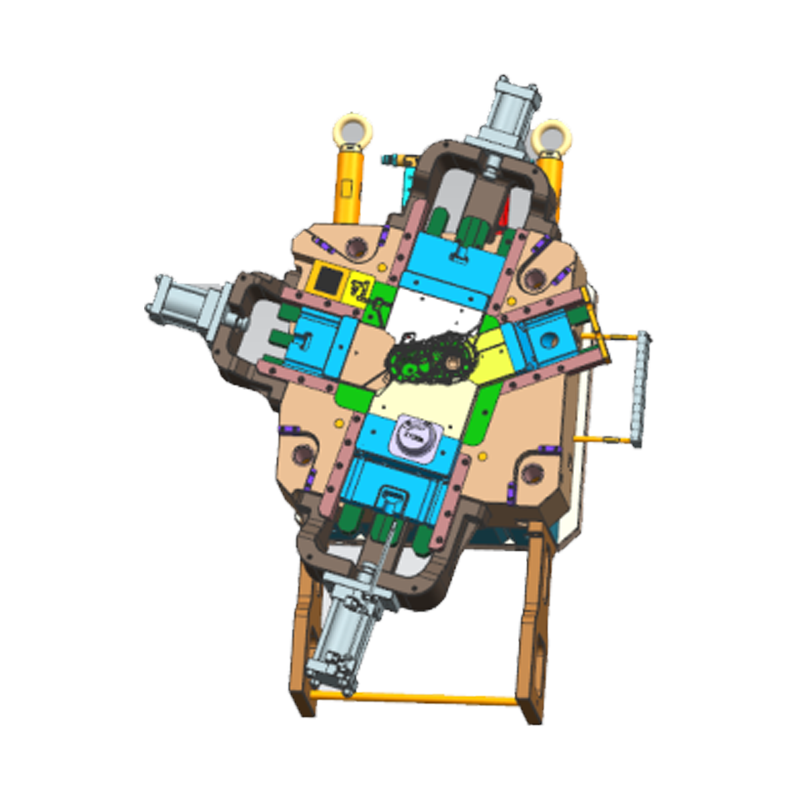
Aluminum die-casting gearbox mold the most critical requirements: 1. Material properties require hig...

Die casting transmission EM Side Housing mold is designed by JYD(Yunmai) for NIO transmission Rear H...

transmission rear Housing molds are foundational to the efficient and precise manufacturing of autom...
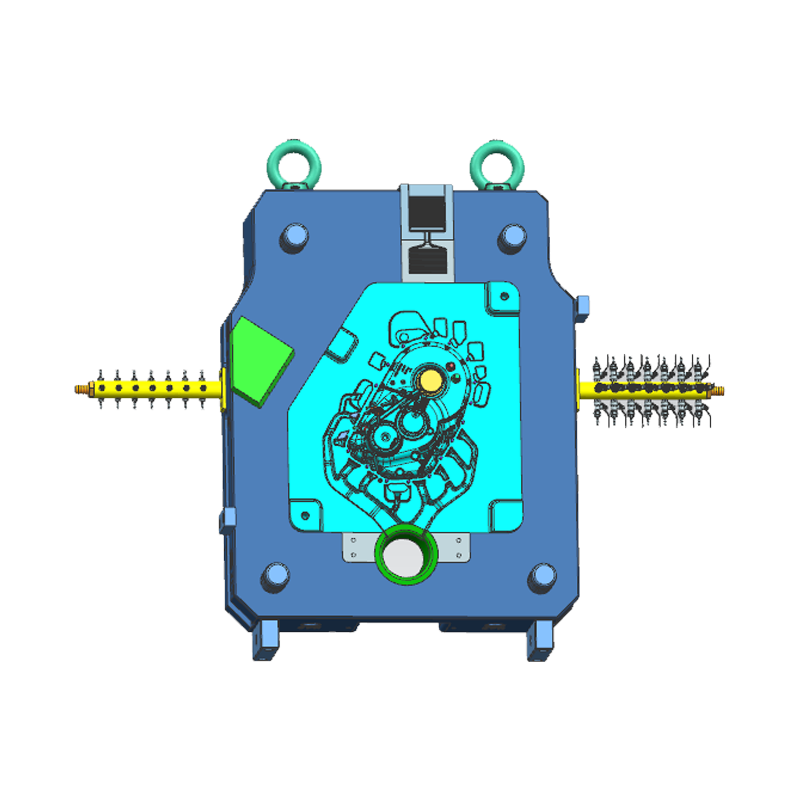
SERES transimission adopts complex cavity structure; high efficiency cooling system, the development...
Copyright © Ningbo Yunmai Precision Machinery Co., Ltd. All Rights Reserved
 OEM/ODM Die Casting/Cast Molds Manufacturers