


Cylinder Head seals combustion chamber, houses valves & spark plugs, forms coolant passages, wit...
Industry News
Home / News / Industry News / Machinery Aluminum Die Cast Mold: The Engineering Behind High-Precision Parts
Content
A machinery aluminum die cast mold is a precision-engineered steel tool used to produce aluminum components at high volume by injecting molten aluminum alloy into a shaped cavity under pressures typically ranging from 1,500 to 25,000 psi. The mold defines every dimension, surface feature, and structural characteristic of the finished part. For machinery applications — covering industrial equipment housings, gearboxes, pump bodies, valve blocks, and structural brackets — mold quality directly determines part dimensional accuracy, cycle time, and total production economics.
Aluminum die casting is the dominant manufacturing process for complex, thin-walled machinery parts that require consistent dimensional accuracy across thousands or millions of cycles. The process offers a combination of properties that few alternatives can match at equivalent production volumes.
Understanding mold architecture is essential for anyone specifying, purchasing, or troubleshooting aluminum die cast tooling for machinery parts. Every mold consists of several functional subsystems that must work in coordination.
The mold splits into a fixed half (cover die, mounted to the stationary platen) and an ejector half (mounted to the moving platen). The parting line between them defines where the mold opens. The cavity — the negative space that shapes the part — is formed by the combined geometry of both halves. For complex machinery parts, the parting line placement critically affects draft angles, surface finish, and ejection force requirements.
Cavity inserts are hardened steel blocks machined to the part geometry and fitted into the mold frame (also called the die base). Using interchangeable inserts allows a single base to accommodate multiple part variants — a cost advantage for machinery product families. Cores create internal features: holes, passages, undercuts, and hollow sections. Moveable side cores (activated by hydraulic cylinders or cam-driven slides) handle features that cannot be formed along the primary pull direction.
Molten aluminum enters through the sprue, travels through runners, and fills the cavity through gates. Gate design — type (fan, tab, edge, direct), size, and location — has the single largest influence on fill pattern, porosity distribution, and surface quality. For machinery structural parts where pressure integrity matters, gate thickness typically ranges from 1.5 to 3.0 mm to control velocity and minimize turbulence-induced porosity.
Overflow wells at the end of flow paths collect the first cold, oxide-laden metal to enter the cavity, improving internal soundness. Vents — typically 0.05–0.15 mm deep channels at the parting line — allow trapped air and gases to escape as metal fills the cavity. Inadequate venting is one of the most common causes of porosity and cold shuts in aluminum die cast machinery parts.
Drilled or gun-bored cooling channels circulate temperature-controlled water (typically maintained at 40–60°C) through the mold to extract heat from solidifying aluminum. Cooling circuit design directly controls solidification rate, dimensional stability, and cycle time. Conformal cooling — channels that follow the part geometry closely — is increasingly used in high-volume molds to reduce cycle times by 15–30% compared to straight-drilled circuits.
Ejector pins, blades, and sleeves push the solidified part out of the cavity after the mold opens. Pin placement must avoid cosmetic surfaces and thin sections. Insufficient draft angles (the taper on vertical walls that allows part release) are a leading cause of ejection damage — aluminum die cast parts for machinery typically require 1° to 3° draft on interior walls and 0.5° to 1.5° on exterior surfaces.
Steel selection is one of the most consequential decisions in die cast mold manufacturing. The mold must withstand repeated thermal cycling between cold (ambient) and hot (aluminum injection at 620–700°C), high injection pressures, and abrasive aluminum flow — all while maintaining dimensional stability over hundreds of thousands of cycles.
| Steel Grade | Hardness (HRC) | Typical Shot Life | Best Used For |
| H13 (SKD61) | 44–48 | 100,000–500,000+ | Cavity inserts, cores — industry standard |
| Premium H13 (ESR) | 44–48 | 500,000–1,000,000+ | High-volume production, complex cores |
| DIN 1.2367 | 44–48 | 300,000–600,000 | Higher thermal fatigue resistance than H13 |
| P20 | 28–34 | Under 50,000 | Prototype molds, low-volume tooling |
| 8407 Supreme | 44–48 | 500,000–800,000 | Demanding thermal cycling applications |
H13 tool steel, vacuum degassed and tempered to 44–48 HRC, remains the global standard for aluminum die cast cavity inserts. For mold frames and support structures, lower-alloy steels such as P20 or 1045 are adequate since they do not contact molten aluminum directly.
Machinery aluminum castings present design challenges that differ from consumer product castings. They are typically larger, heavier, structurally loaded, and subject to dimensional inspection against engineering drawings with GD&T callouts.
Abrupt wall thickness changes cause differential solidification rates, leading to shrinkage porosity and warpage. Machinery part designs should transition between thick and thin sections gradually, maintaining a 3:1 maximum thickness ratio between adjacent walls. Where thick bosses or ribs are unavoidable, coring them out reduces both porosity risk and part weight.
Industrial gearbox housings, pump bodies, and valve manifolds often have features on multiple faces that prevent a simple flat parting line. Stepped or angled parting lines, multiple slides, and lifters are used to capture undercuts while keeping mold complexity and cost manageable. Each slide adds approximately 15–25% to mold cost — a trade-off that must be evaluated against part design flexibility.
Most machinery aluminum die cast parts require CNC machining of critical bores, sealing surfaces, and mounting faces after casting. The mold must incorporate 0.3 to 1.5 mm of machining stock on these surfaces. Failing to account for this at the mold design stage results in either insufficient material for cleanup or oversized castings that drive up machining cost.
Hydraulic housings, pneumatic valve bodies, and fluid manifolds cast for machinery use must pass leak tests — typically at 5–30 bar depending on application. Internal porosity from poorly designed gating or inadequate intensification pressure causes test failures. For these parts, vacuum-assisted die casting (drawing cavity vacuum to 50–100 mbar before injection) is commonly specified to reduce gas porosity by 60–80% compared to conventional die casting.
The alloy specified for a machinery die casting must balance castability, mechanical properties, corrosion resistance, and machinability. The following table summarizes the most widely used options:
| Alloy | Tensile Strength (MPa) | Castability | Machinability | Typical Machinery Use |
| A380 | 324 | Excellent | Good | General housings, brackets, covers |
| ADC12 (A383) | 310 | Excellent | Very Good | Intricate thin-wall parts, valves |
| A360 | 317 | Good | Good | Pressure-tight parts, marine equipment |
| A413 | 296 | Excellent | Fair | Complex thin-wall hydraulic components |
| Silafont-36 (A356) | 340+ (T6 heat treated) | Good | Excellent | Structural chassis and load-bearing parts |
The lead time and cost of an aluminum die cast mold for machinery parts depends on part complexity, cavity count, and mold size. A single-cavity mold for a mid-size machinery housing typically takes 8 to 14 weeks from design approval to first article samples. The manufacturing sequence follows these stages:
Understanding failure modes helps buyers specify molds correctly and helps production engineers maintain them effectively.
The most common mold failure mode in aluminum die casting. Repeated thermal cycling creates a network of surface cracks (heat checks) that eventually transfer to part surfaces as raised lines. Prevention includes adequate mold preheating to 150–200°C before production starts, controlled cooling channel temperatures, and using premium H13 or 1.2367 steel with consistent through-hardening.
Molten aluminum bonds to mold steel at high velocity gate areas and sharp corners, causing surface damage and part defects. Solutions include increasing gate thickness to reduce metal velocity, applying nitriding or PVD coatings (CrN, TiAlN) to gate areas, and ensuring adequate release agent application.
High-velocity aluminum erodes gate steel over time, causing dimensional drift in gate dimensions and worsening fill characteristics. Gate inserts made from higher-hardness tool steel (50–52 HRC) or hot-work die steel with surface nitriding extend service life significantly. Gate areas should be inspected and measured every 20,000–30,000 shots in high-volume production.
Thin fins of aluminum form at the parting line when clamping force is insufficient or parting line surfaces wear. For machinery parts, flash in threaded or sealing areas is a functional defect requiring rework. Maintaining proper clamping force (calculated as projected area × injection pressure × safety factor of 1.25) and regular parting line surface inspection prevents premature flash issues.
A well-maintained aluminum die cast mold for machinery production should achieve 200,000 to 500,000+ shots before major refurbishment. Consistent preventive maintenance is the primary driver of reaching that target.
Maintaining a mold logbook tracking shot count, repairs, dimensional measurements, and observed defects is the single most effective practice for predicting maintenance needs and avoiding unexpected production stoppages.
Mold cost for machinery aluminum die castings varies widely based on part complexity, required shot life, and sourcing geography. Understanding cost drivers prevents budget surprises and helps buyers make informed trade-offs.

Cylinder Head seals combustion chamber, houses valves & spark plugs, forms coolant passages, wit...

The camshaft bracket cover secures the camshaft position, seals oil channels to prevent leaks, block...
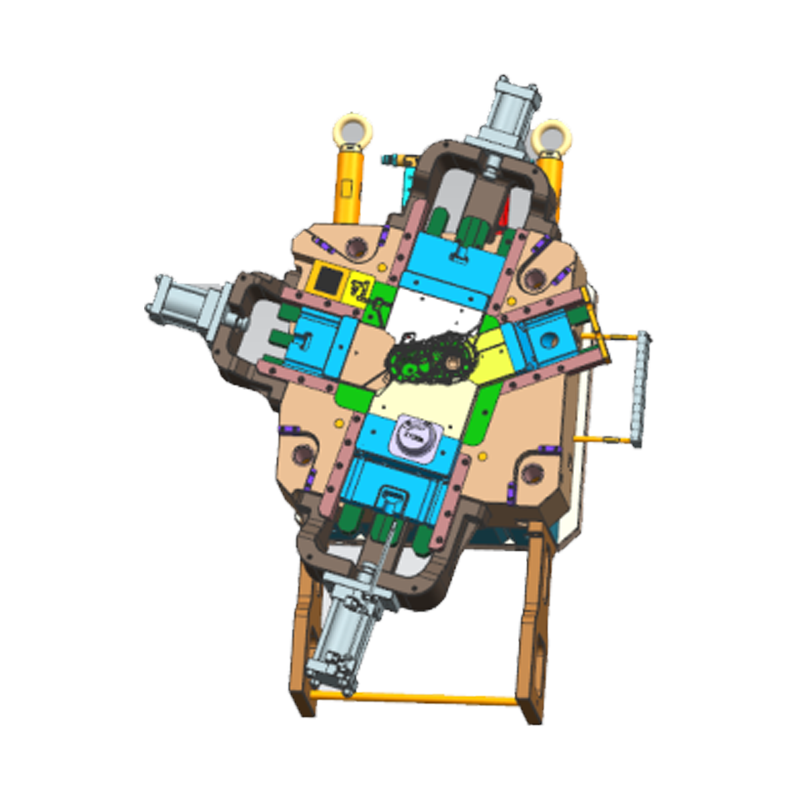
Aluminum die-casting gearbox mold the most critical requirements: 1. Material properties require hig...

Die casting transmission EM Side Housing mold is designed by JYD(Yunmai) for NIO transmission Rear H...

transmission rear Housing molds are foundational to the efficient and precise manufacturing of autom...
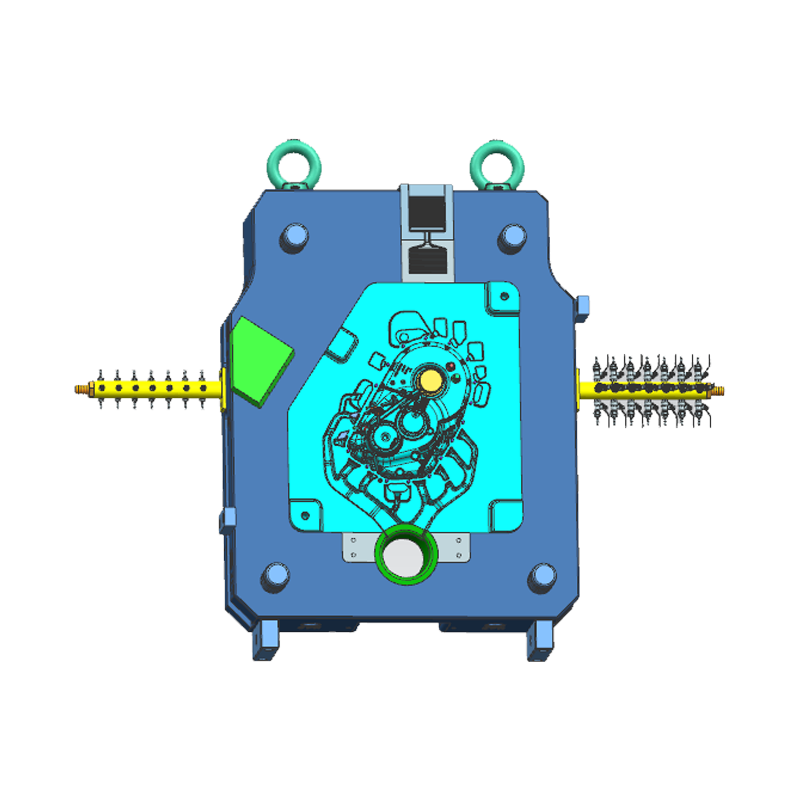
SERES transimission adopts complex cavity structure; high efficiency cooling system, the development...
Copyright © Ningbo Yunmai Precision Machinery Co., Ltd. All Rights Reserved
 OEM/ODM Die Casting/Cast Molds Manufacturers