


Cylinder Head seals combustion chamber, houses valves & spark plugs, forms coolant passages, wit...
Content
The most widely used magnesium alloys for die casting are AZ91D, AM60B, and AM50A — each offering a distinct balance of strength, ductility, and castability suited to different engineering requirements. AZ91D dominates general-purpose applications with the best combination of strength and corrosion resistance, while AM60B and AM50A are preferred where energy absorption and elongation matter more than hardness. Magnesium alloy die castings are valued across automotive, electronics, and aerospace sectors because magnesium is the lightest structural metal, approximately 33% lighter than aluminum and 75% lighter than steel, enabling significant weight savings without sacrificing structural integrity.
Magnesium alloys are uniquely well-suited to high-pressure die casting (HPDC) for several interconnected reasons. Pure magnesium has a density of only 1.74 g/cm³ — compared to 2.70 g/cm³ for aluminum and 7.87 g/cm³ for steel — making it the go-to choice when mass reduction is a design priority.
Beyond weight, magnesium alloys offer processing advantages that make them commercially attractive:
These properties have made magnesium alloy die castings standard components in automotive instrument panel structures, steering column brackets, seat frames, and consumer electronics housings.
Magnesium die casting alloys are designated by a letter-number system defined by ASTM. The letters indicate the primary and secondary alloying elements (A = aluminum, Z = zinc, M = manganese, S = silicon, E = rare earth), and the numbers indicate their approximate weight percentages.
AZ91D contains approximately 9% aluminum and 1% zinc, with controlled manganese content for corrosion resistance. It accounts for roughly 90% of all magnesium die casting production globally and is the default choice when no special functional requirement favors another alloy.
AZ91D is favored because it offers the highest yield strength and ultimate tensile strength in the standard die casting alloy family, good castability, and the best general corrosion resistance of the common Mg-Al alloys due to tightly controlled iron, copper, and nickel impurity limits (each below 0.005%).
AM60B contains 6% aluminum and 0.3% manganese with no zinc addition. Reducing aluminum from 9% to 6% decreases strength slightly but substantially increases elongation — AM60B achieves 8% elongation compared to AZ91D's 3%. This makes it the preferred alloy for automotive safety-critical components such as steering wheels, seat frames, and door inner panels where crash energy absorption is a design requirement.
AM50A contains 5% aluminum and delivers the highest elongation (up to 10%) of the standard die casting alloys, at the cost of lower tensile strength. It is used in applications requiring maximum deformation before fracture, such as instrument panel cross-car beams and rollover protection structures in convertible vehicles.
Standard AZ and AM alloys lose significant creep resistance above 120°C due to softening of the Mg₁₇Al₁₂ intermetallic phase at grain boundaries. For powertrain applications like transmission cases, oil pans, and engine brackets, elevated-temperature alloys are required:
The table below compares the key mechanical properties of the most important magnesium die casting alloys under ASTM standards, providing a data-driven basis for alloy selection:
| Alloy | UTS (MPa) | Yield Strength (MPa) | Elongation (%) | Hardness (HRB) | Max Service Temp. |
|---|---|---|---|---|---|
| AZ91D | 230 | 160 | 3 | 73 | ~120°C |
| AM60B | 220 | 130 | 8 | 65 | ~120°C |
| AM50A | 210 | 125 | 10 | 60 | ~120°C |
| AS41B | 215 | 140 | 6 | 62 | ~150°C |
| AE44 | 230 | 150 | 10 | 61 | ~175°C |
Magnesium alloy die castings are found across a wide range of industries, with automotive representing the largest market at roughly 70% of total consumption.
Every kilogram saved in a vehicle reduces fuel consumption by approximately 0.06–0.08 liters per 100 km over the vehicle's life. Typical magnesium die cast automotive components include:
The electronics industry uses AZ91D extensively for laptop housings, camera bodies, smartphone structural frames, and tablet shells. Magnesium provides excellent EMI (electromagnetic interference) shielding — attenuation of up to 90 dB at frequencies from 30 MHz to 1 GHz — a significant advantage over plastic enclosures.
In aerospace, where every gram matters, magnesium alloy die castings appear in helicopter gearbox housings, aircraft seat frames, and avionics enclosures. Specialized alloys with rare earth additions are used where operating temperatures exceed 150°C.
Power tool housings, chainsaw bodies, and bicycle components benefit from magnesium's light weight combined with sufficient rigidity. AZ91D is the standard alloy for these applications, providing a finished part weight reduction of 30–35% versus comparable aluminum castings.
Magnesium alloy die castings are produced using two main process variants, each with distinct advantages:
Most magnesium die casting uses the hot chamber (gooseneck) process because magnesium's low iron solubility allows the injection system to be submerged in the melt without significant erosion. Key parameters for magnesium hot chamber casting include:
Cold chamber casting is used for larger, heavier magnesium parts where hot chamber machine capacity is insufficient. The molten metal is ladled into the shot sleeve for each cycle. Injection pressures are higher (70–140 MPa), producing denser castings with lower porosity — preferred for structural automotive applications.
Molten magnesium oxidizes rapidly and can ignite if exposed to air or moisture. Modern die casting facilities protect the melt surface using a cover gas mixture of SF₆ and CO₂ or SO₂, or dry air with proprietary inhibitors. SF₆ concentrations as low as 0.2% by volume in the cover gas are sufficient to suppress oxidation. This safety requirement adds process complexity but is well-established in commercial operations.
Corrosion resistance is the most frequently cited limitation of magnesium alloys. Unprotected magnesium has a standard electrode potential of –2.37 V, making it highly anodic and susceptible to galvanic corrosion when in contact with most other structural metals.
However, the high-purity designation of modern alloys (AZ91D, AM60B) addresses the primary corrosion mechanism. Research established that limiting iron content below a critical ratio of Fe/Mn ≤ 0.032 reduces corrosion rate by a factor of 10–100× compared to older, lower-purity alloys. AZ91D in salt spray testing (ASTM B117) now achieves corrosion rates comparable to die cast aluminum alloy 380.
Surface treatments applied to magnesium die castings for corrosion protection include:
Alloy selection for magnesium die castings should be driven by a structured evaluation of functional requirements. Use the following decision framework:
For the majority of commercial die casting projects — enclosures, brackets, structural frames — AZ91D remains the default starting point and should only be substituted when specific testing or functional analysis demonstrates a clear advantage in switching to AM60B, AM50A, or a high-temperature alloy.

Cylinder Head seals combustion chamber, houses valves & spark plugs, forms coolant passages, wit...

The camshaft bracket cover secures the camshaft position, seals oil channels to prevent leaks, block...

Aluminum die-casting gearbox mold the most critical requirements: 1. Material properties require hig...

Die casting transmission EM Side Housing mold is designed by JYD(Yunmai) for NIO transmission Rear H...

transmission rear Housing molds are foundational to the efficient and precise manufacturing of autom...
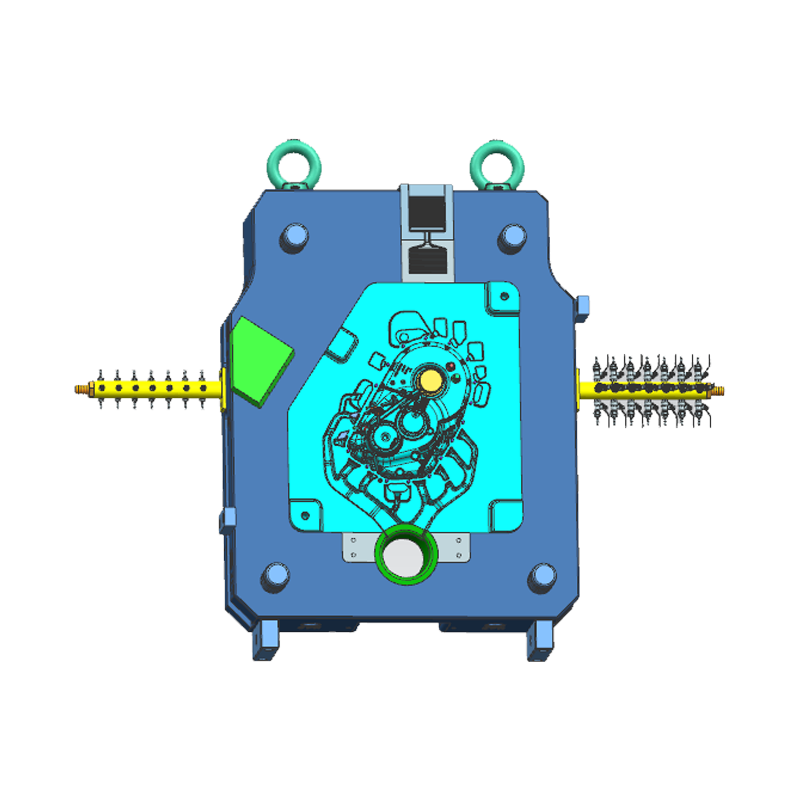
SERES transimission adopts complex cavity structure; high efficiency cooling system, the development...
Copyright © Ningbo Yunmai Precision Machinery Co., Ltd. All Rights Reserved
 OEM/ODM Die Casting/Cast Molds Manufacturers