


Cylinder Head seals combustion chamber, houses valves & spark plugs, forms coolant passages, wit...
Content
A casting mold is a precision-engineered tool cavity into which molten metal is injected or poured under pressure to produce a near-net-shape part. A die cast mold — also called a die or die casting die — is the specific type used in high-pressure die casting (HPDC), where molten metal is forced into a hardened steel cavity at pressures ranging from 10 MPa to over 150 MPa. The result is a dimensionally accurate, high-volume metal component produced in seconds per cycle. Aluminum die cast molds dominate the industry, followed by magnesium, zinc, and copper alloys. This guide explains what each mold type is, how they differ by material and application, and what determines mold quality and service life.
A casting mold is any tool or container that defines the external geometry of a cast part. The term spans a wide range of manufacturing processes — sand casting, investment casting, gravity casting, and die casting each use a different category of mold. In industrial manufacturing, the most precise and productive of these is the die cast mold.
Every die cast mold consists of the same fundamental structural elements, regardless of the alloy being cast:
| Mold Type | Tooling Material | Pressure | Surface Finish | Typical Volume |
| Sand casting mold | Bonded sand | Gravity | Ra 12–25 µm | 1–10,000 parts |
| Investment casting mold | Ceramic shell | Gravity / low | Ra 1.6–3.2 µm | 100–100,000 parts |
| Gravity die (permanent mold) | Steel or cast iron | Gravity | Ra 3.2–6.3 µm | 1,000–100,000 parts |
| High-pressure die cast mold | H13 / H11 tool steel | 10–150 MPa | Ra 0.8–3.2 µm | 50,000–1,000,000+ parts |
| Comparison of major casting mold types by process, tooling material, and production volume suitability | ||||
The die cast mold's advantage is clear at high volumes: cycle times of 15–90 seconds per shot, tight dimensional tolerances (typically ±0.1mm on critical features), and the ability to produce complex thin-walled geometries that would be impossible in sand or gravity casting.
Aluminum die casting accounts for approximately 80% of all non-ferrous die casting production globally. The aluminum die cast mold is specifically engineered to manage the thermal and mechanical demands of casting aluminum alloys — primarily A380, A360, ADC12, and A383 — at melt temperatures of 620–700°C.
The standard mold steel for aluminum die casting is H13 (AISI H13 / DIN 1.2344) hot-work tool steel, heat-treated to 44–48 HRC. H13 is chosen for its combination of:
A well-maintained aluminum die cast mold in H13 steel, properly nitrided and operated within designed parameters, can achieve:
Magnesium alloys (primarily AZ91D, AM60, and AM50) are the lightest structural die casting metals — approximately 35% lighter than aluminum and 75% lighter than steel by volume. Magnesium die cast molds must account for the unique physical and chemical properties of magnesium, which differs from aluminum in several technically important ways.
| Parameter | Aluminum (A380) | Magnesium (AZ91D) |
| Melt temperature | 640–700°C | 620–680°C |
| Injection pressure | 30–80 MPa | 30–70 MPa |
| Gate velocity | 20–50 m/s | 40–80 m/s |
| Cycle time advantage | Baseline | ~20–30% faster (faster solidification) |
| Fire/oxidation risk | Low | High — requires SF₆ or SO₂ cover gas |
| Soldering to die face | Moderate risk | Lower risk than aluminum |
| Erosion of die surface | Moderate | Higher (higher gate velocity) |
| Key process parameter differences between aluminum and magnesium high-pressure die casting | ||
Magnesium die cast molds are widely used in automotive steering wheels, instrument panel frames, seat frames, and portable electronic device housings where the weight saving over aluminum justifies the more complex process management.
The motorcycle industry is one of the most demanding applications for die cast molds because a single motorcycle contains 30 to 80 individual die cast components — spanning structural, aesthetic, and functional parts — often produced in both aluminum and magnesium alloys within the same production facility.
| Component | Alloy | Key Requirement | Typical Wall Thickness |
| Engine crankcase | Aluminum (ADC12) | Pressure tightness, dimensional accuracy | 3–6 mm |
| Cylinder head cover | Aluminum (A380) | Thin wall, surface finish for visual | 2–4 mm |
| Swing arm | Aluminum (A356-T6) | High fatigue strength, low porosity | 4–8 mm |
| Handlebar controls housing | Magnesium (AZ91D) | Weight minimisation, tactile surface | 1.5–3 mm |
| Wheel hub | Aluminum (A356) | Concentricity, balance, strength | 5–12 mm |
| Frame junction plates | Aluminum (A380) | Structural integrity, weldability | 4–10 mm |
| Common die cast components on a motorcycle, grouped by alloy and structural role | |||
Motorcycle die cast molds frequently require 4 to 8 slide cores per mold half to create the ports, threaded bosses, and undercuts characteristic of engine and frame components. A crankcase mold for a 4-cylinder engine may contain 12 or more individual slides and take 6–9 months to design, manufacture, and validate. Tooling costs for a complete crankcase die set typically range from $80,000 to $250,000 USD, depending on part complexity and number of cavities.
Pressure tightness is a non-negotiable requirement for motorcycle engine components. Porosity rates must be controlled to below 0.5% by volume for oil-retaining parts; this drives the use of vacuum-assisted die casting (VADC) on critical engine components, which requires the mold to be sealed and evacuated before each shot.
Machinery aluminum die cast molds produce structural and functional components for industrial equipment — hydraulic pump bodies, gearbox housings, compressor end-caps, electric motor frames, and pneumatic valve manifolds. These molds differ from consumer product molds in three important ways: larger part size, higher structural integrity requirements, and longer production runs.
Industrial machinery parts are frequently large — hydraulic valve manifolds can weigh 2–8kg as-cast, and electric motor housings for industrial drives can exceed 15kg. Casting these parts requires die casting machines with clamping forces of 1,600 to 4,400 tonnes, compared to 400–800 tonnes typical for small consumer parts. The mold itself may weigh 5,000–25,000 kg and require overhead crane handling for installation and removal.
Machinery aluminum die cast components are often subject to dynamic loads, pressure cycles, and elevated temperatures in service. This places strict requirements on the casting itself — and by extension on the mold that produces it:
Unlike automotive body panels that run at millions of units per year, machinery components often require 5,000–100,000 parts annually — making mold investment costs a significant factor per unit. A single-cavity machinery aluminum die cast mold with full slides and vacuum assist typically costs $50,000–$180,000 USD. At lower annual volumes, this is amortised over a longer period, making mold durability and repairability especially important. Mold designers for machinery applications therefore favour heavier wall sections, more conservative cooling designs, and easily replaceable wear components in gate and runner areas.
Understanding how a die cast mold is manufactured helps buyers and engineers set realistic expectations for lead time, cost, and qualification. The process is consistent across aluminum, magnesium, and motorcycle applications, though complexity and duration vary.
Total lead time from mold order to production approval ranges from 8 weeks (simple single-cavity) to 6 months (complex multi-slide structural part). Rushing this timeline — particularly heat treatment and trial shot iterations — is a primary cause of premature mold failure and dimensional non-conformance in production.
Die cast mold investment is one of the largest upfront costs in any high-volume casting project. Understanding what drives cost and what extends or shortens mold life allows buyers to make better sourcing and design decisions.

Cylinder Head seals combustion chamber, houses valves & spark plugs, forms coolant passages, wit...

The camshaft bracket cover secures the camshaft position, seals oil channels to prevent leaks, block...
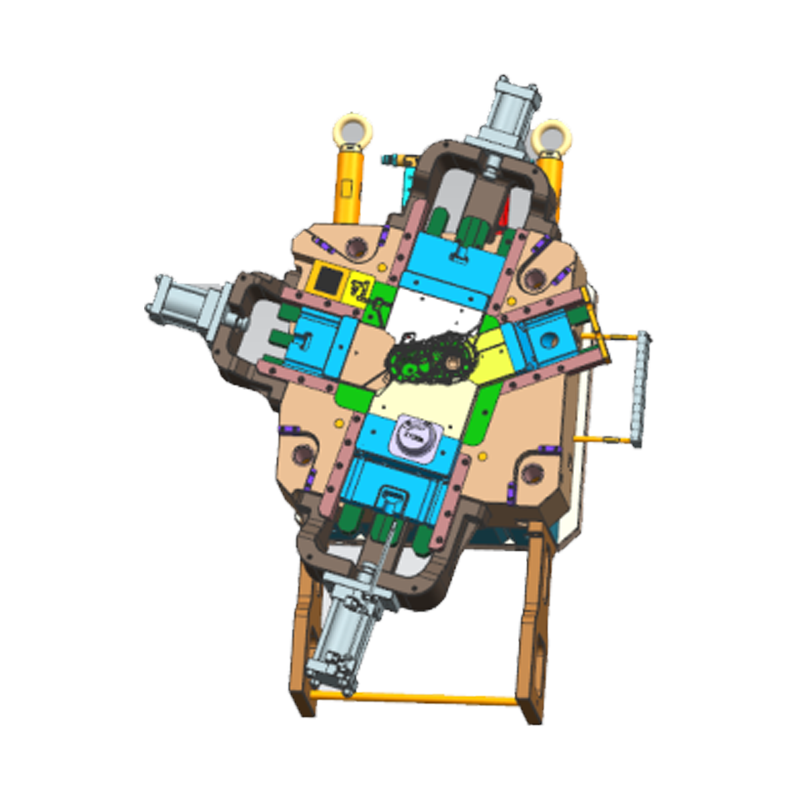
Aluminum die-casting gearbox mold the most critical requirements: 1. Material properties require hig...

Die casting transmission EM Side Housing mold is designed by JYD(Yunmai) for NIO transmission Rear H...

transmission rear Housing molds are foundational to the efficient and precise manufacturing of autom...
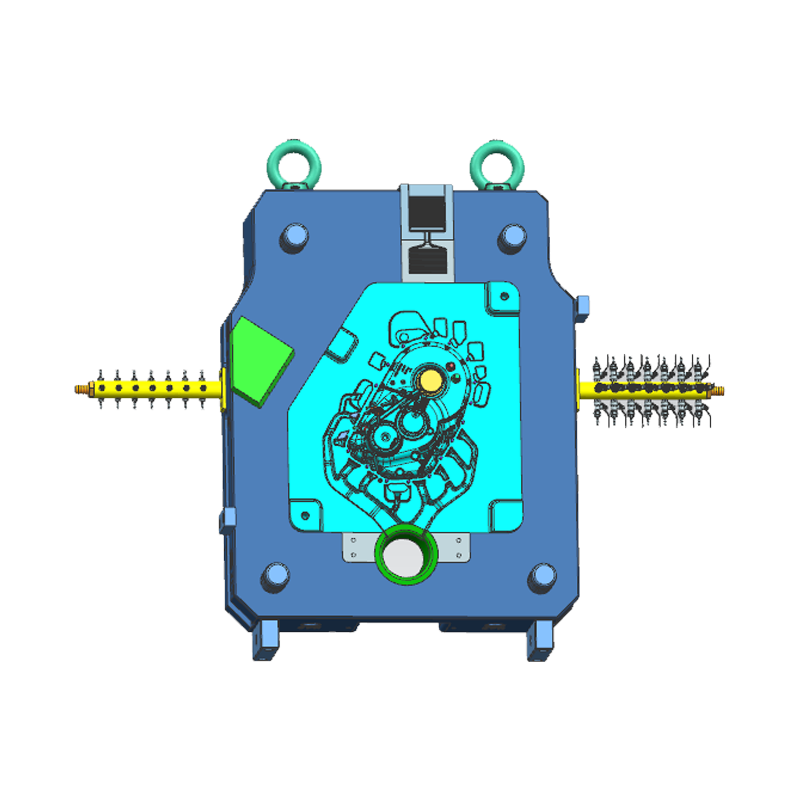
SERES transimission adopts complex cavity structure; high efficiency cooling system, the development...
Copyright © Ningbo Yunmai Precision Machinery Co., Ltd. All Rights Reserved
 OEM/ODM Die Casting/Cast Molds Manufacturers