


Cylinder Head seals combustion chamber, houses valves & spark plugs, forms coolant passages, wit...
Content
Aluminum die casting molds — also called dies — are precision steel tools that shape molten aluminum alloy into complex, near-net-shape components through repeated high-pressure injection cycles. A well-designed aluminum die casting mold can produce 100,000 to over 1,000,000 parts before requiring replacement, making tooling cost one of the most significant upfront investments in any die casting project. The mold defines every critical attribute of the finished part: dimensional accuracy, surface finish, wall thickness, and internal geometry.
The global aluminum die casting market was valued at approximately $56 billion in 2023 and continues to grow, driven by automotive lightweighting, consumer electronics miniaturization, and structural aerospace applications. For engineers, product designers, and procurement teams, understanding how aluminum die casting molds work, how they are designed, and what drives their cost and longevity is essential to making sound manufacturing decisions.
An aluminum die casting mold consists of two primary halves — the cover die (fixed half) and the ejector die (moving half) — that close together under high clamping force to form a sealed cavity. Molten aluminum, typically heated to 620–700°C (1,150–1,290°F), is injected into this cavity at pressures ranging from 1,000 to 30,000 PSI depending on the process and part complexity.
The complete casting cycle proceeds as follows:
High-pressure die casting (HPDC) cycle times for aluminum parts typically range from 15 to 120 seconds, enabling production rates of 30–250 shots per hour depending on part size and complexity.
The steel used to manufacture an aluminum die casting mold is the single most critical material decision in tooling engineering. Die steel must withstand extreme thermal cycling, high injection pressures, erosive aluminum flow, and chemical attack from molten metal and die lubricants — simultaneously and repeatedly for hundreds of thousands of cycles.
| Steel Grade | Typical Hardness (HRC) | Key Properties | Typical Application | Expected Die Life (shots) |
|---|---|---|---|---|
| H13 (AISI) | 44–48 | Excellent thermal fatigue resistance, good toughness | Standard cavities and cores — industry default | 150,000–500,000 |
| Premium H13 (ESR/VAR) | 44–48 | Superior cleanliness, reduced inclusions, extended fatigue life | High-volume production dies | 500,000–1,000,000+ |
| DIN 1.2367 (W360) | 46–50 | Higher hot strength, good erosion resistance | Gate inserts, high-erosion zones | 200,000–600,000 |
| Maraging Steel (C300) | 52–56 | Very high toughness and hardness, excellent polishability | Thin cores, fine details, high-polish surfaces | 100,000–300,000 |
H13 tool steel processed via electroslag remelting (ESR) is the industry benchmark for high-volume aluminum die casting. ESR processing reduces sulfide inclusions and improves steel cleanliness — directly translating to fewer crack initiation sites and significantly longer thermal fatigue life compared to standard H13.
A complete aluminum die casting mold assembly is a complex engineered system with interdependent subsystems. Understanding each component's function is essential for evaluating mold designs, troubleshooting casting defects, and managing tooling maintenance.
The cavity forms the external surface of the casting; the core forms internal features and holes. These are typically machined as separate inserts pressed into a bolster (die holder) frame. Using inserts allows damaged sections to be replaced without scrapping the entire mold — reducing tooling cost significantly over the die's service life. Critical cavity surfaces are machined to tolerances of ±0.005 mm or tighter on premium tooling.
The runner system channels molten aluminum from the shot sleeve to the cavity gates. Gate design is one of the most critical and technically demanding aspects of die design — gate velocity, area, location, and geometry directly control fill pattern, porosity, surface finish, and dimensional accuracy. Common gate types include:
Overflow wells capture the first metal to enter the cavity — which carries trapped air, oxides, and cold shot — preventing these defects from remaining in the finished part. Vents (typically 0.05–0.12 mm deep for aluminum) allow displaced air to escape without allowing metal to flash through. Inadequate venting is one of the leading causes of porosity in aluminum die castings.
Conformal cooling channels drilled or machined through the die inserts carry temperature-controlled water or oil to extract heat from the solidifying casting. Thermal balance is the single most important factor in cycle time optimization and dimensional consistency. Die surface temperatures for aluminum casting are typically maintained between 150–250°C (300–480°F). Thermal imbalance causes warping, uneven solidification, sink marks, and accelerated thermal fatigue cracking.
Ejector pins, blades, and sleeves push the solidified casting out of the die after opening. Pin placement is critical — poorly located ejector pins cause part distortion, witness marks on cosmetic surfaces, and can crack thin-wall features. Ejector pin diameter, material (usually H13 or nitrided steel), and surface treatment must be matched to the local casting geometry and ejection forces required.
Undercuts — features that cannot be formed by simple mold open/close movement — require slides (external side actions) or lifters (internal angled actions) that move laterally during die opening. Each slide adds significant cost and complexity to the mold: a single external slide typically adds $5,000–$20,000 to tooling cost depending on size and complexity. Minimizing undercuts during part design is the most effective way to control mold cost.
Molds are classified not only by their structural design but by how many parts they produce per shot — a decision that directly affects tooling cost, per-part cost, and production flexibility.
| Mold Type | Parts per Shot | Relative Tooling Cost | Best Application |
|---|---|---|---|
| Single cavity | 1 | Lowest | Large parts, low-to-medium volumes, prototypes |
| Multi-cavity (same part) | 2, 4, 8, 16+ | Medium–High | High-volume small parts (connectors, brackets) |
| Family mold (different parts) | 2–6 (different) | Medium | Matched assemblies, low-volume component sets |
| Unit die (insert in common holder) | 1 (interchangeable) | Low (per insert) | Prototype and low-volume development parts |
For small, high-volume parts like automotive fastener bosses or electronic housings, 16-cavity or 32-cavity molds are not uncommon — enabling per-part cycle costs below $0.10 at full production throughput. The breakeven volume between a single-cavity and multi-cavity tool typically falls between 50,000 and 200,000 parts per year depending on part size and machine time cost.
Effective mold design for aluminum die casting requires simultaneous optimization of multiple competing constraints: fill quality, solidification control, ejection reliability, thermal balance, and tool longevity. The following principles are fundamental to sound die design.
All surfaces parallel to the direction of die opening must include draft angles to allow part release without dragging. Standard draft for aluminum die casting is 1–3° on external surfaces and 2–5° on internal cores. Insufficient draft causes galling, scoring of die surfaces, and ejection-related distortion. Deeper pockets and taller bosses require proportionally more draft.
Non-uniform wall thickness creates differential solidification rates that cause porosity, warpage, and sink marks. Recommended wall thickness for aluminum HPDC is 1.5–4 mm for most structural applications, with abrupt transitions replaced by gradual tapers. Ribs should not exceed 60–70% of the adjacent wall thickness to prevent shrinkage porosity at the rib base.
The parting line is where the two die halves meet. Its placement must allow the part to release cleanly, must not cross cosmetic or functional surfaces where flash would be unacceptable, and should minimize the number of slides required. A well-placed parting line can eliminate the need for one or two slides — saving $10,000–$40,000 in tooling cost on a complex part.
Modern die design universally employs casting simulation software (MAGMASOFT, ProCAST, FLOW-3D) before any steel is cut. Simulation predicts fill pattern, air entrapment locations, solidification sequence, porosity risk areas, and thermal distribution. Addressing simulation-identified issues before machining reduces first-article rejection rates by 40–70% according to industry benchmarks, and prevents costly mid-production tooling modifications.
Aluminum die casting is capable of producing parts with tight tolerances and excellent as-cast surface finish — but achievable tolerances depend on part size, geometry complexity, and tooling quality.
Dimensional variation in die casting comes from multiple sources: thermal expansion of the die during production warm-up, shot-to-shot variation in injection parameters, die wear over time, and part distortion during ejection. Statistical process control (SPC) monitoring of critical dimensions during production runs is standard practice in automotive-tier die casting operations.
Tooling cost is the most significant upfront variable in an aluminum die casting project. Mold prices vary from $5,000 for a simple prototype insert to over $500,000 for a complex multi-cavity automotive structural die. Understanding cost drivers helps project teams make informed decisions about design complexity and production volume thresholds.
Mold life is primarily limited by thermal fatigue cracking (heat checking) — a network of surface cracks caused by the repeated expansion and contraction of die steel as it absorbs heat from each injection cycle and is cooled by die lubricant and internal cooling. Extending mold life from 200,000 to 500,000 shots on a $100,000 tool can save $150,000 in tooling amortization over a production program.
Starting production with a cold die creates catastrophic thermal shock — the largest single cause of premature heat checking. Dies should be preheated to 150–200°C (300–390°F) using dedicated die heating equipment or slow initial cycles before full production speed is established. Preheating alone can extend thermal fatigue life by 20–40%.
Excessive die lubricant application causes rapid surface quenching — dramatically increasing thermal cycling stress. Modern trend is toward minimal die lubrication (MDL) or dry lubrication techniques that reduce lubricant volume while maintaining release performance, reducing thermal shock and improving surface quality of castings.
Structured preventive maintenance at defined shot intervals dramatically extends die service life:
Several surface treatments extend die life by improving hardness, reducing thermal fatigue, and providing erosion resistance:
Many casting quality issues trace directly back to mold design decisions rather than process parameters. Understanding the mold-design root causes of common defects enables engineers to address problems at the source rather than compensating with process adjustments that may introduce other issues.
| Defect | Mold-Related Root Cause | Design Correction |
|---|---|---|
| Porosity | Insufficient venting, poor overflow placement, trapped air | Increase vent depth/number, relocate overflows to last-fill areas |
| Cold shuts | Metal fronts meeting before fully liquid, long fill paths | Add fill points, increase gate area, optimize runner geometry |
| Soldering (sticking) | Insufficient draft, die overheating, gate erosion | Increase draft angles, apply PVD coating, reposition gate |
| Flash | Parting surface wear, insufficient clamping, vent too deep | Resurface parting line, verify clamping tonnage, reduce vent depth |
| Warpage / distortion | Thermal imbalance, uneven ejection force, inadequate support | Balance cooling circuit, redistribute ejector pins, add support pillars |
| Surface blistering | Sub-surface porosity expanding during heat treatment or painting | Improve venting, add vacuum assistance, optimize intensification pressure |

Cylinder Head seals combustion chamber, houses valves & spark plugs, forms coolant passages, wit...

The camshaft bracket cover secures the camshaft position, seals oil channels to prevent leaks, block...
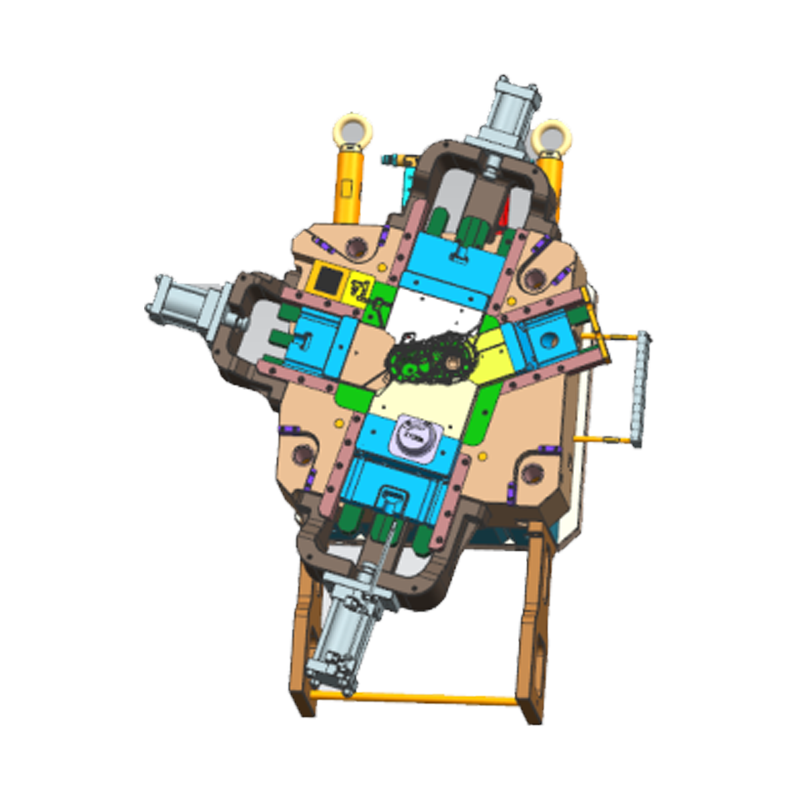
Aluminum die-casting gearbox mold the most critical requirements: 1. Material properties require hig...

Die casting transmission EM Side Housing mold is designed by JYD(Yunmai) for NIO transmission Rear H...

transmission rear Housing molds are foundational to the efficient and precise manufacturing of autom...
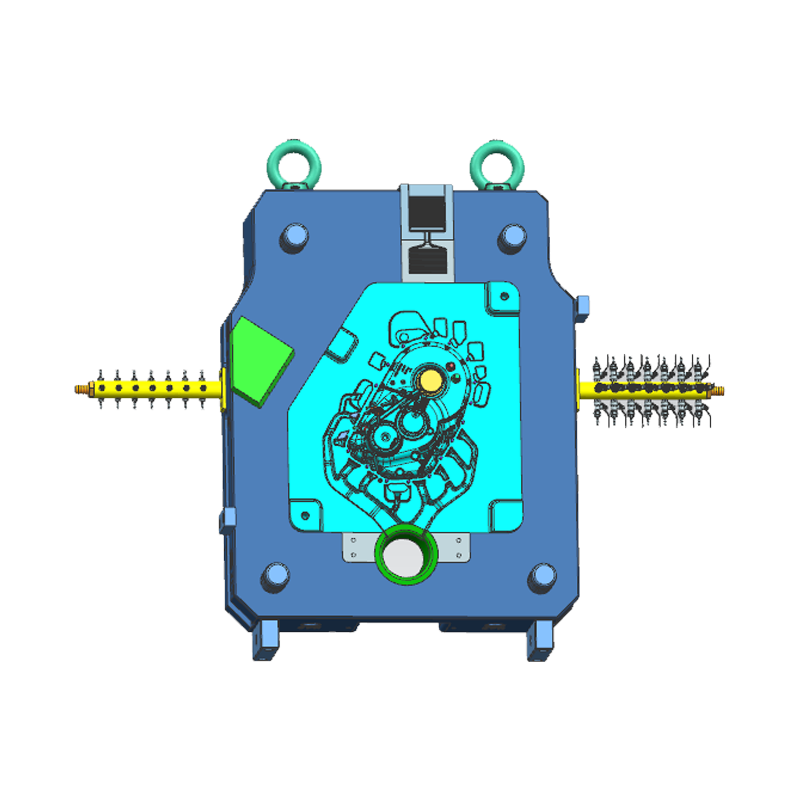
SERES transimission adopts complex cavity structure; high efficiency cooling system, the development...
Copyright © Ningbo Yunmai Precision Machinery Co., Ltd. All Rights Reserved
 OEM/ODM Die Casting/Cast Molds Manufacturers