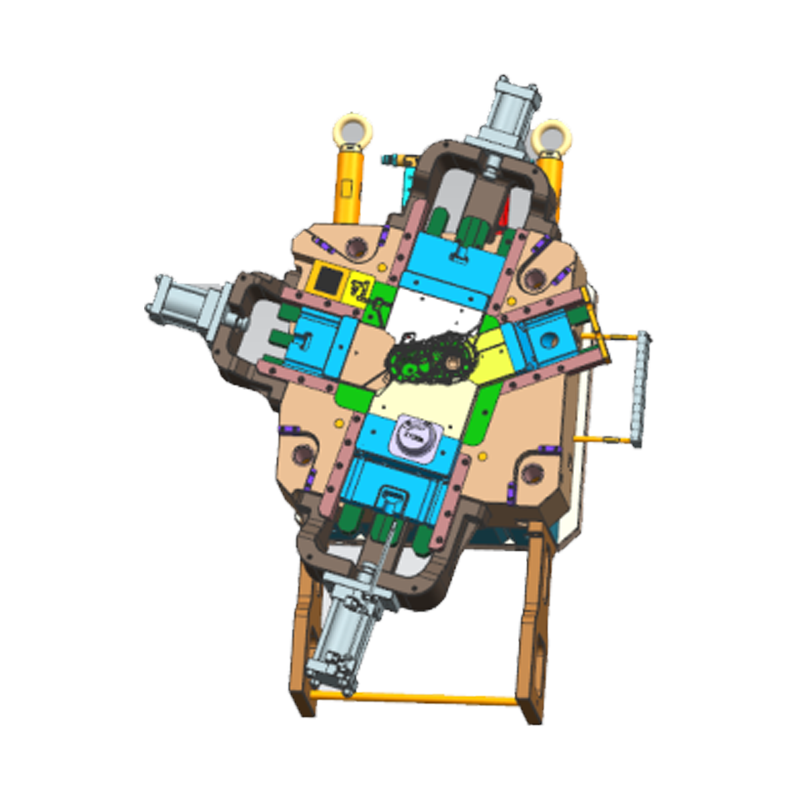
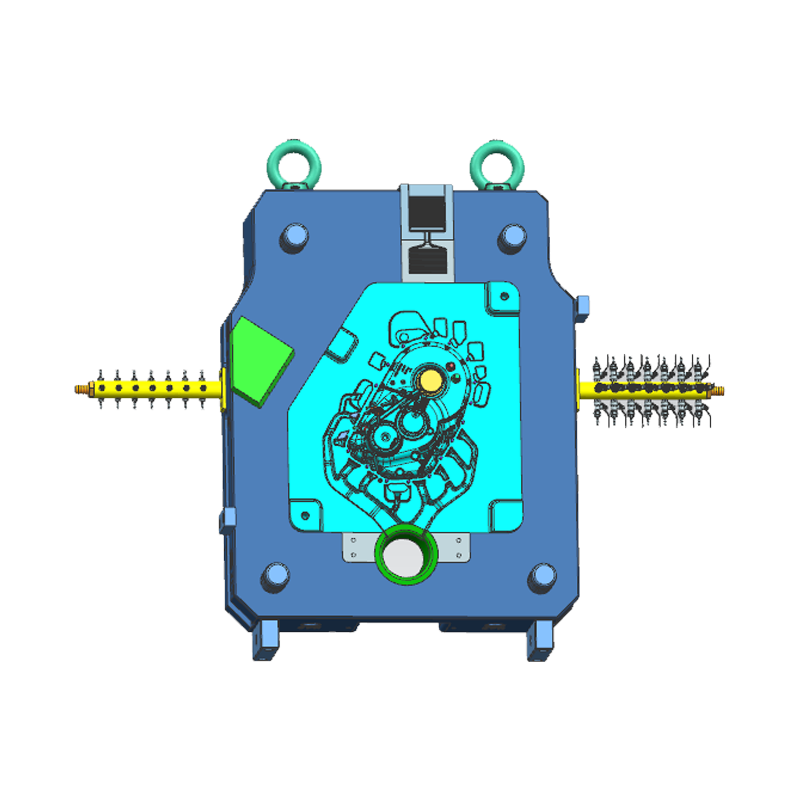
Lamp components Aluminum Die Castings are the standard choice for lamp components — housings, heat sinks, brackets, and end caps — because high-pressure die casting produces complex, thin-walled shapes in one step while delivering the thermal conductivity a lighting fixture needs to keep its LEDs cool and long-lived.
The dominant alloy is ADC12, valued for a thermal conductivity commonly cited between roughly 96–150 W/m·K, a low density of about 2.7 g/cm³, and excellent castability for the intricate fin geometry a heat sink needs. Die casting becomes the more economical manufacturing route than CNC machining or extrusion once volume clears a few hundred to a few thousand units — below that threshold, the upfront mold investment often doesn't pay back fast enough to beat machining a small batch directly.
Why Die Casting Is the Standard Process for Lamp Parts
A lighting fixture asks a lot of its metal parts at once: pull heat away from the LED board, hold precise dimensions for optical alignment, resist outdoor weathering, and look presentable on a retail shelf. High-pressure die casting satisfies all four in a single forming step, which is why it dominates production for lamp housings, heat sinks, and structural brackets.
| Fixture requirement | How die casting delivers it |
|---|---|
| Heat dissipation | Dense, high-pressure-formed aluminum conducts LED heat away efficiently, extending diode lifespan |
| Complex geometry | Molten metal fills intricate fin arrays and mounting features in a single shot, no assembly of separate pieces |
| Dimensional accuracy | Rapid solidification under pressure holds tight, repeatable tolerances across large batches |
| Surface finish | Smooth as-cast surfaces reduce the need for extensive secondary finishing before coating or anodizing |
| Strength-to-weight | Low aluminum density keeps fixtures light without sacrificing structural rigidity |
ADC12 Material Properties Lighting Engineers Should Know
Not every aluminum alloy performs the same in a lamp housing. ADC12 is the industry default for a reason — its balance of castability, thermal transfer, and mechanical strength suits the thin walls and fine fin structures typical of LED heat sinks.
| Property | Typical value |
|---|---|
| Density | Approximately 2.7 g/cm³ |
| Thermal conductivity | Roughly 90–150 W/m·K depending on source and process condition |
| Tensile strength (as-cast) | 230–280 MPa; up to 290–310 MPa after T5 heat treatment |
| Yield strength | Approximately 140–170 MPa |
| Elongation | Roughly 1.0–3.0%, moderate ductility |
| Hardness | Approximately HB75–100 |
ADC12 Compared to Other Common Die Cast Options
ADC12 — the lighting default
- Excellent castability for intricate fin and housing geometry
- Strong corrosion resistance for outdoor and marine-adjacent fixtures
- Reliable dimensional stability through rapid solidification
- Cost-effective — widely recycled and readily available
A380 — the mechanical alternative
- Higher mechanical strength and better machinability
- Preferred where extensive post-casting machining is expected
- Slightly lower corrosion resistance than ADC12 in harsh settings
- Better suited to structural parts than fine-fin heat sinks
Post-casting steps matter as much as the alloy: CNC machining the surfaces that contact the LED board improves flatness and thermal transfer beyond what the as-cast surface alone provides, while T6 or T7 heat treatment raises structural strength without meaningfully reducing the alloy's thermal conductivity.
Die Casting vs. CNC Machining vs. Extrusion for Lamp Parts
The right manufacturing process depends almost entirely on production volume and part geometry, not on which method is inherently "better." Choosing wrong in either direction — over-investing in tooling for a short run, or machining a part that should be cast — is the most common source of avoidable cost overrun in a lighting program.
| Factor | Die casting | CNC machining | Extrusion |
|---|---|---|---|
| Best volume range | Several hundred to hundreds of thousands of units | Prototypes, low volume, evolving designs | Low volume or uniform cross-section profiles |
| Tooling cost | High upfront — steel molds; aluminum soft tooling can cut this by up to 85% | Minimal — no dedicated mold required | Lower than die casting, but limited to uniform profiles |
| Geometry freedom | Highest — complex 3D shapes, fins, and undercuts in one shot | High, but complex shapes add machining time and cost | Limited to consistent cross-sections along the length |
| Typical lead time to first parts | 3–5 weeks (soft tooling) to 12–16 weeks (steel production tooling) | Days | Days to a few weeks |
| Cost trend at scale | Cost per part drops sharply as volume rises | Cost per part stays roughly flat regardless of volume | Competitive for high volumes of uniform profiles |
A Practical Volume Threshold
As a general rule of thumb echoed across manufacturing guidance: die casting requires upfront tooling investment but becomes dramatically more cost-effective once production scales beyond several hundred parts, while CNC machining remains the better fit for prototypes or tolerance-critical, low-volume runs. A pilot batch of 50 precision parts is a textbook case for CNC; a production run in the thousands is a textbook case for a die casting mold.
What Determines Die Casting Mold Cost and Complexity
Two lamp housings of similar weight can require very different tooling investments. Mold cost is driven by geometry and finishing requirements, not by the part's size or material alone — which is why an accurate quote depends on more than a target price and a product name.
- Wall thickness consistency: uniform walls reduce warping risk and simplify the mold; sudden thickness changes are a common source of both tooling complexity and part defects.
- Undercuts and side features: slides, inserts, and cores add mechanical complexity to the tool and increase both cost and maintenance requirements over the mold's service life.
- Sealing and cosmetic surfaces: parts requiring pressure-tight seals or a polished, consumer-facing finish often need secondary CNC machining, polishing, or coating after casting.
- Draft angles: adequate draft on every vertical face is what allows the part to release from the mold without damage; missing draft is one of the most common and costly design oversights when converting a machined part to a cast one.
- Target annual volume and expected order batch sizes
- 3D model or drawing showing wall thickness and draft angles
- Any sealing, threading, or tight-tolerance surfaces the part requires
- Cosmetic finish expectations — as-cast, machined, anodized, or coated
- Whether the design is finalized or still likely to change before production
Sourcing Molds and Castings for Your Lighting Program
Getting the alloy, wall thickness, and mold design right the first time avoids costly tooling revisions once production begins. A design-for-manufacturing review before cutting steel is the single most reliable way to catch these issues early.