


Cylinder Head seals combustion chamber, houses valves & spark plugs, forms coolant passages, wit...
Content
Machinery aluminum die castings are aluminum alloy components — housings, brackets, gear cases, covers, and structural parts — produced by injecting molten aluminum into a reusable steel die under high pressure. They are the standard choice for machinery components when production volume exceeds roughly 5,000 units, part weight stays under about 20 kg, and the design needs tight-tolerance, repeatable geometry straight out of the mold.
This is not the right process for every machinery part, though. Die casting machines have tonnage limits that rule out very large industrial housings, and some applications — like gearbox casings that need superior vibration damping — are still better served by cast iron. The rest of this article breaks down exactly where aluminum die casting fits, with the alloy data, tolerance figures, and cost breakpoints you need to make that call.
Alloy selection is the single decision that most affects a die-cast part's strength, machinability, and corrosion resistance. Nearly all machinery die castings come from the aluminum-silicon 3xx.x family, and A380 is the default choice for the large majority of machinery components — power tool housings, gear cases, motor housings, and structural brackets — because it balances strength, fluidity, and machinability at a reasonable cost.
| Alloy | Key Strength | Typical Machinery Use |
| A380 | Best overall balance, easiest to machine | Gear cases, motor housings, brackets |
| A360 | Superior corrosion resistance, high-temp strength | Marine and outdoor equipment housings |
| ADC12 | Best die-fill for thin, intricate shapes | Thin-wall covers, high-detail small parts |
| A413 | Excellent pressure tightness | Hydraulic cylinders, pressure vessels |
| B390 | Very high wear resistance and hardness | Engine blocks, high-wear components |
A useful rule of thumb: reach for A360 when the part faces harsh, corrosive, or high-temperature environments — it costs more and is harder to cast, but the corrosion resistance is significantly better than A380. Reach for ADC12, the regional equivalent of A380 widely used across Asia, when a part has aggressively thin walls or fine cosmetic detail, since its higher silicon content improves fluidity and dimensional accuracy.
Dimensional accuracy is governed in North America by NADCA (North American Die Casting Association) product specification standards, which define two tolerance grades: Standard and Precision.
In practical terms, a worked example from NADCA specification tables shows a 5-inch (127 mm) feature holding a Standard tolerance of about ±0.014 in. once the linear and projected-area tolerances are combined. Precision tolerances cost more to hold in production, so the most cost-effective designs apply Precision specs only to functional, mating, or sealing surfaces — and leave every non-critical dimension at Standard.
The decision between die casting and its two main alternatives — sand casting and CNC machining from billet — comes down almost entirely to production volume, because die casting front-loads its cost into the tooling and then delivers a very low per-part price.
One published case study on an aluminum part put sand casting tooling at $1,500 with a per-part cost of $32, against die casting tooling of $22,000 with a per-part cost of $16.20. At a run of 1,000 pieces, sand casting is still cheaper overall. But the break-even point lands around 1,300 pieces, and by 10,000 pieces, die casting saves nearly $140,000 compared to sand casting. A separate example on a 3-pound industrial pump housing found the die-cast conversion made sense at just 1,273 parts once total finished cost — not just piece price — was accounted for.
For a component like a gearbox housing, die casting generally makes sense for aluminum housings under 20 kg in production runs exceeding 5,000 units, with tooling costs ranging from $50,000 to $500,000+ that pay off through sharply lower per-unit costs at volume. Machining from billet, by contrast, wins below roughly 50 units or whenever the design is still likely to change, since it needs no tooling investment and lead times are measured in days rather than the weeks a die requires.
| Process | Tooling Cost | Best Volume Range |
| CNC machining from billet | None | Under 50 units, or evolving designs |
| Sand casting | $1,500 – $4,000 (pattern) | Low to medium volume, large parts |
| Aluminum die casting | $22,000 – $500,000+ (die) | 5,000+ units, repeatable geometry |
One caveat worth flagging directly: the popular guideline of "under 500 units, machine; over 5,000, cast" was calculated for small precision parts, not large gearbox-style housings. For bigger machinery components, run the specific tooling and per-part numbers for your part rather than applying a generic rule.
Beyond raw cost, aluminum die casting delivers three practical advantages that matter specifically for machinery components.
These advantages are why aluminum die castings show up throughout general machinery: gear cases, motor and power-tool housings, structural brackets, electronics enclosures, and telecom chassis all lean on the same combination of light weight, dimensional stability, and thermal conductivity.
No process is universally correct, and machinery designers run into three recurring limits with conventional high-pressure die casting.
Conventional high-pressure die casting traps small amounts of gas during the high-speed fill, and this porosity generally prevents full T6 solution heat treatment, since the trapped gas expands at high temperature and causes blistering or dimensional distortion. Most machinery die castings instead use T5 low-temperature aging, which improves properties without triggering that expansion. Specialized methods like vacuum die casting, squeeze casting, or thixocasting can reduce porosity enough to allow heat treatment, but each comes with a real cost penalty.
Porosity also matters directly for parts that must hold pressure or seal against fluid — pump bodies, valve bodies, and hydraulic-adjacent housings. If leak performance is required, the test method and acceptance limit need to be defined before tooling begins, not discovered afterward when a machined sealing surface exposes hidden voids.
Die casting machines carry tonnage limits that rule out very large industrial housings, and for continuous-duty gearbox casings specifically, gray cast iron still outperforms aluminum on vibration damping — a property that directly affects gearbox noise and bearing life when a housing has to absorb harmonics from gears running for extended shifts.
Before releasing a machinery part to tooling, confirm the following to avoid rework and cost surprises later in the program.
Get these six decisions right at the design stage, and machinery aluminum die castings deliver exactly what the process is known for: light, dimensionally stable, repeatable parts at a per-unit cost that alternatives cannot match once volume climbs into the thousands.

Cylinder Head seals combustion chamber, houses valves & spark plugs, forms coolant passages, wit...

The camshaft bracket cover secures the camshaft position, seals oil channels to prevent leaks, block...
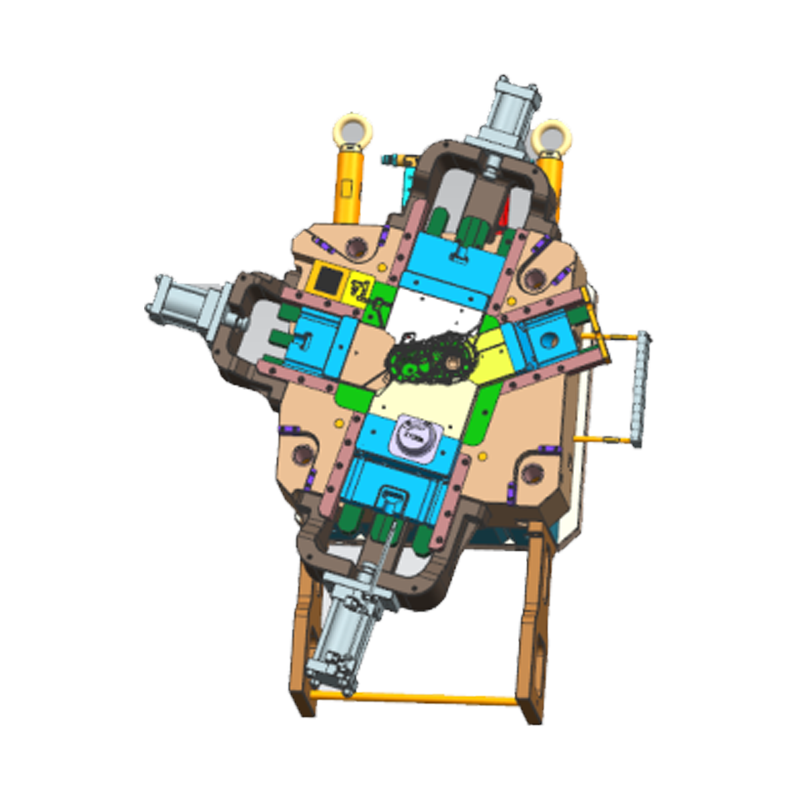
Aluminum die-casting gearbox mold the most critical requirements: 1. Material properties require hig...

Die casting transmission EM Side Housing mold is designed by JYD(Yunmai) for NIO transmission Rear H...

transmission rear Housing molds are foundational to the efficient and precise manufacturing of autom...
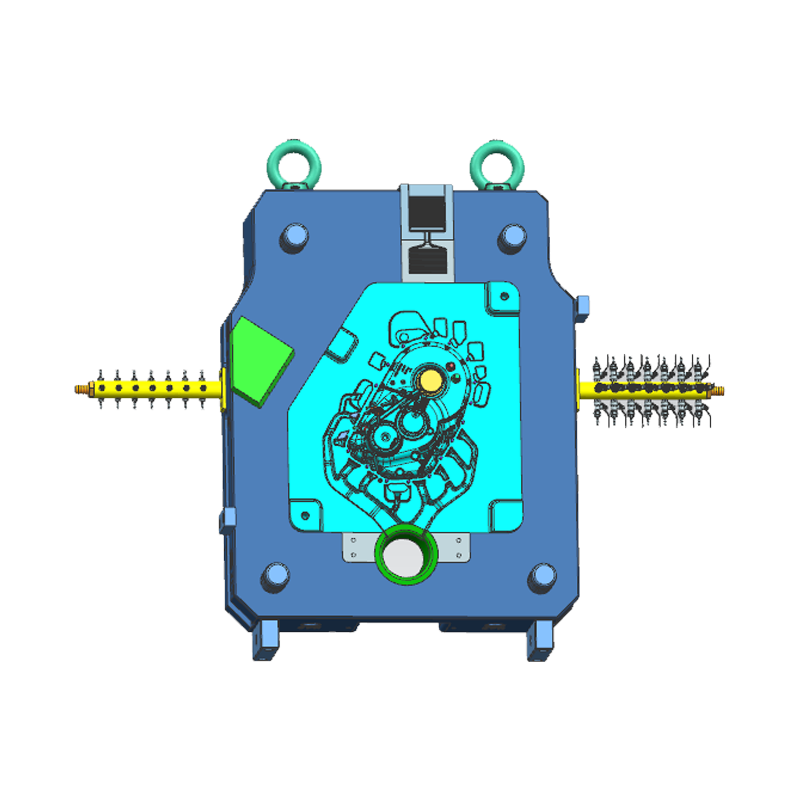
SERES transimission adopts complex cavity structure; high efficiency cooling system, the development...
Copyright © Ningbo Yunmai Precision Machinery Co., Ltd. All Rights Reserved
 OEM/ODM Die Casting/Cast Molds Manufacturers