


Cylinder Head seals combustion chamber, houses valves & spark plugs, forms coolant passages, wit...
Industry News
Home / News / Industry News / Motorcycle Aluminum Die Castings: A Complete Guide to Materials, Manufacturing, and Selection
Content
Aluminum die casting is the dominant manufacturing process for structural and mechanical motorcycle components. It produces parts with tight dimensional tolerances, high strength-to-weight ratios, and complex internal geometries that no other mass-production method can match at equivalent cost. From engine crankcases and transmission housings to swingarm brackets and handlebar clamps, the majority of critical load-bearing aluminum parts on a modern motorcycle are die cast — a fact that holds true across entry-level commuters, sport bikes, and heavyweight cruisers alike.
Understanding how motorcycle die cast parts are made, which alloys are used, and what separates a precision casting from a substandard one is essential for engineers, procurement teams, and anyone specifying or evaluating aluminum components for motorcycle applications.
Motorcycles impose a uniquely demanding set of requirements on their structural components: low mass to maximize power-to-weight ratio, thermal stability for engine-adjacent parts, vibration resistance for long service life, and geometric complexity to integrate multiple functions into single castings. Aluminum die casting satisfies all of these simultaneously.
Aluminum's density is approximately 2.7 g/cm³, roughly one-third that of steel at 7.85 g/cm³. A die-cast aluminum crankcase that would weigh 4.5 kg in cast iron weighs under 1.6 kg — a saving that directly improves handling, fuel efficiency, and rider fatigue over long distances. For high-performance motorcycles where every kilogram matters, this advantage is irreplaceable. Honda's CBR600RR, for example, uses die-cast aluminum for its main frame sections, contributing to a total wet weight of just 189 kg despite a full chassis and 600cc inline-four engine.
High-pressure die casting (HPDC) injects molten aluminum into a hardened steel die at pressures between 10,000 and 30,000 psi and cycle times as short as 15–60 seconds per shot. For a manufacturer producing tens of thousands of engines per month, this throughput is impossible to match with sand casting, forging, or machining from billet. The dies themselves — typically H13 tool steel — last 80,000 to 150,000 shots before requiring replacement, making the per-part tooling amortization cost extremely low at volume.
Die casting allows internal passages, bosses, ribs, threaded inserts, and mounting features to be cast in a single operation. An aluminum die-cast engine crankcase can incorporate oil passages, bearing bores, cooling fins, and structural ribs in one part that would require five or six machined and welded components in an alternative process. This integration reduces assembly labor, eliminates potential leak paths, and improves overall structural stiffness.
Producing a precision motorcycle aluminum die casting involves a tightly controlled sequence of operations. Variation at any stage propagates into dimensional error, porosity, or mechanical property degradation in the finished part.
Die design is the most consequential step in the entire process. The die must account for aluminum's volumetric shrinkage of approximately 3.5–5% during solidification, which requires compensating geometry in all critical dimensions. Gate location, runner geometry, and overflow placement determine how the molten metal fills the cavity — poor fill patterns cause cold shuts, misruns, and porosity concentrations. Simulation software (such as MAGMASOFT or ProCAST) is now standard for die design validation on motorcycle components before any steel is cut.
Aluminum alloy ingots are melted in reverberatory or crucible furnaces and held at a precisely controlled temperature — typically 620–700°C (1,148–1,292°F) depending on alloy grade. Metal temperature directly affects fluidity, fill behavior, and surface quality. Degassing with nitrogen or argon is performed before casting to remove dissolved hydrogen, which forms porosity bubbles during solidification. Hydrogen content in well-degassed aluminum should be below 0.1 mL/100g for structural motorcycle castings.
The die casting machine's shot sleeve receives a metered volume of molten aluminum. A hydraulic plunger then drives the metal into the die cavity in two phases: a slow first phase to fill the runner without turbulence, followed by a fast second phase at high velocity to fill the part cavity before premature solidification. The metal solidifies under intensification pressure — a third-phase pressure applied after cavity fill — which compresses any remaining porosity and improves density in thick sections. Total solidification typically occurs within 2–10 seconds after injection.
After solidification, ejector pins push the casting from the die. The runner system, overflows, and flash are trimmed in a trim die while the part is still warm enough for clean shearing. Critical bores and mating surfaces are then CNC machined to final tolerance — typically ±0.05 mm or tighter for bearing housings and sealing surfaces. Heat treatment (T5 or T6 temper) may be applied to high-stress structural castings to improve yield strength.
Not all aluminum alloys are suitable for die casting, and not all die-casting alloys are appropriate for every motorcycle application. Alloy selection drives the trade-offs between castability, mechanical strength, thermal resistance, and corrosion performance.
| Alloy | Key Composition | Tensile Strength (as-cast) | Key Properties | Typical Motorcycle Application |
|---|---|---|---|---|
| A380 (ADC12) | Al-Si8.5-Cu3.5 | ~317 MPa | Excellent castability, good strength, low cost | Crankcases, gearbox housings, covers |
| A383 (ADC10) | Al-Si10-Cu2 | ~310 MPa | Better fluidity than A380, finer detail capability | Thin-wall brackets, instrument housings |
| A360 | Al-Si9-Mg0.5 | ~296 MPa | Superior corrosion resistance, pressure tightness | Hydraulic components, coolant housings |
| A413 | Al-Si12 | ~296 MPa | Excellent fluidity, complex thin sections | Carburettor bodies, intricate covers |
| Silafont-36 (AlSi10MnMg) | Al-Si10-Mn0.6-Mg0.3 | ~340 MPa (T7: ~360 MPa) | High ductility, heat-treatable, structural | Frame nodes, swingarm pivot sections |
A380/ADC12 remains the workhorse alloy for motorcycle die cast applications globally due to its balance of castability, mechanical performance, and raw material cost. However, newer vacuum-assisted and structural die casting processes increasingly use low-iron, high-ductility alloys like Silafont-36 that support heat treatment after casting — a capability standard A380 does not offer due to its copper content causing blistering during solution treatment.
The range of components produced as motorcycle aluminum die castings spans the entire machine — from powertrain internals to chassis brackets and body structure. Each application places specific demands on the casting's properties.
Engine components represent the highest-volume and most technically demanding motorcycle die cast parts. Crankcases must maintain precise bearing bore alignment across temperature ranges from cold start (-20°C) to fully warmed operating conditions (over 120°C at the crankcase surface), while resisting oil pressure internally and carrying the structural loads of the entire engine assembly. Cylinder heads — particularly for liquid-cooled engines — incorporate complex internal water jackets, valve seat bores, and spark plug bosses all cast in a single aluminum die casting.
Modern sport and adventure motorcycles increasingly use large-format die castings for chassis nodes — sections that previously required welded steel fabrications. BMW's S1000RR and Ducati's Panigale V4 both use aluminum die-cast main frame sections that integrate the steering head, engine mount points, and swingarm pivot in a single casting, eliminating welds at the highest-stress joints in the chassis.
Die-cast aluminum's thermal conductivity — approximately 96 W/m·K for A380 — makes it the preferred housing material for components that generate or must dissipate heat. Alternator covers, voltage regulator housings, and LED headlamp bezels with integrated heat sinks are increasingly specified in aluminum die cast to manage electronics thermal loads without adding dedicated cooling systems.
Porosity — small voids within the casting — is the single most significant quality concern in motorcycle aluminum die castings. It reduces mechanical properties, causes pressure leaks in fluid-carrying components, and creates failure initiation sites under cyclic loading. Managing porosity is the primary technical challenge that separates high-quality motorcycle die cast suppliers from commodity producers.
Gas porosity forms from dissolved hydrogen released during solidification, producing round, smooth-walled voids typically 0.1–2 mm in diameter. Shrinkage porosity forms where liquid metal cannot feed solidifying regions fast enough, producing irregular, rough-walled voids in thick sections or areas remote from the gate. Both types reduce fatigue life — studies have shown that porosity-free aluminum HPDC samples achieve fatigue lives 3–5 times longer than equivalent samples with 1–2% porosity by volume.
Vacuum-assisted high-pressure die casting (VHPDC) evacuates the die cavity to below 50 mbar absolute pressure before injection, eliminating the majority of trapped air that causes gas porosity. Parts produced this way can be heat-treated (unlike standard HPDC parts, where entrapped gas expands during solution treatment and creates surface blisters), opening the possibility of T6 temper treatment that can increase yield strength by 40–60% over as-cast condition. Premium motorcycle structural castings — including frame nodes and steering heads — increasingly specify VHPDC for this reason.
Several non-destructive and destructive inspection methods are used to characterize porosity in motorcycle die castings:
As-cast aluminum surfaces are adequate for internal, unexposed components, but most visible or corrosion-exposed motorcycle die cast parts require surface treatment to achieve the required appearance and durability.
Shot blasting with steel or ceramic media removes die release agent residue, minor flash, and surface oxides. It also imparts a compressive residual stress layer that improves fatigue resistance — shot-peened aluminum surfaces show fatigue life improvements of 15–30% compared to as-machined surfaces in rotating bending tests. Tumbling in abrasive media is used for small castings to achieve a uniform matte finish before coating or anodizing.
Anodizing converts the aluminum surface into a hard aluminum oxide layer, improving corrosion resistance and wear resistance. Hard anodizing (Type III) produces layers 25–100 µm thick with hardness comparable to mild steel (HV 300–500), making it the standard finish for high-wear surfaces on motorcycle die castings such as fork crown clamps, handlebar risers, and brake caliper mounts. Standard Type II anodizing (10–25 µm) provides the decorative colored finishes seen on aftermarket and OEM accessories.
Powder coating provides a durable organic finish in a wide range of colors and textures, with typical film thicknesses of 60–120 µm. E-coating (electrodeposition coating) is used for corrosion-critical structural castings on OEM motorcycles — it achieves complete coverage of complex internal geometries that spray coatings cannot reach, providing a consistent primer layer before topcoat application. Many OEM crankcase castings receive an e-coat primer followed by powder topcoat in corrosion-prone markets.
Engine covers, rocker covers, and decorative castings on cruiser and custom motorcycles often receive mechanical polishing to a mirror or brushed finish. This is technically demanding on die cast parts because porosity exposed at the surface becomes highly visible after polishing — it demands either very low-porosity castings from the outset or an impregnation process to seal surface-connected voids before polishing.
Die casting is not the only manufacturing route for aluminum motorcycle components. Understanding where it excels and where alternatives are more appropriate is essential for engineering decisions and supplier evaluation.
| Process | Dimensional Accuracy | Mechanical Properties | Tooling Cost | Cycle Time | Best For |
|---|---|---|---|---|---|
| High-Pressure Die Casting | ±0.1–0.3 mm as-cast | Good (limited heat treat) | High ($30K–$300K+) | 15–60 sec/shot | High-volume complex parts |
| Gravity Die Casting | ±0.3–0.8 mm | Good (heat-treatable) | Medium ($5K–$50K) | 2–5 min/shot | Medium volume, structural parts |
| Sand Casting | ±0.8–2.0 mm | Moderate | Low ($500–$5K) | 10–30 min/part | Prototypes, low volume, large parts |
| Forging | ±0.2–0.5 mm (post-machine) | Excellent (grain flow) | High ($20K–$150K) | 30–120 sec/part | Swingarms, wheels, triple clamps |
| CNC Machining from Billet | ±0.01–0.05 mm | Excellent | Low (no tooling) | Minutes to hours/part | Racing, custom, prototypes |
Forging remains the preferred process for swingarms, triple clamps, and wheel hubs on premium motorcycles because forged grain flow structure delivers superior fatigue resistance under the bending and torsional loads these parts experience. However, die casting is irreplaceable for complex enclosed geometries — crankcases, gearbox housings, and cylinder blocks cannot be forged or cost-effectively machined from billet at production volumes.
OEM motorcycle manufacturers and serious aftermarket suppliers specify quality requirements through a combination of industry standards, internal engineering specifications, and supplier qualification processes. Understanding these requirements is essential when selecting a motorcycle aluminum die casting supplier.
Several technological developments are actively reshaping what is achievable in motorcycle die cast production, driven by the dual pressures of electrification and increasing structural integration requirements.
Tesla's adoption of large-format single-piece die castings (gigacasting) for automotive rear underbodies has prompted motorcycle manufacturers to explore equivalent approaches for frame structures. A rear frame assembly that currently requires 20–30 individual stamped and welded steel or extruded aluminum components can potentially be replaced with a single large-format die casting. BMW Motorrad and several emerging electric motorcycle manufacturers are actively developing this approach, targeting assembly part count reductions of 50–70% and corresponding reductions in assembly labor and weld inspection requirements.
Semi-solid metal (SSM) casting processes inject aluminum in a partially solidified, thixotropic state rather than fully liquid. This eliminates most of the turbulence-induced porosity of conventional HPDC and produces castings with porosity levels below 0.1% by volume — approaching wrought aluminum quality — while maintaining the geometric complexity of die casting. For motorcycle suspension and steering components where both complex geometry and high fatigue life are required, SSM casting offers a compelling alternative to the forging/machining route at medium production volumes.
Topology optimization software combined with die casting process simulation now allows engineers to generate motorcycle die cast part geometries that are simultaneously optimized for structural efficiency and manufactureability. Wall thicknesses, rib configurations, and draft angles are automatically adjusted by the software to minimize mass while keeping porosity below acceptable limits and ensuring complete die fill. Lead times from concept to validated production-ready die design have fallen from 18–24 months to under 12 months for complex motorcycle engine castings using fully integrated simulation workflows.

Cylinder Head seals combustion chamber, houses valves & spark plugs, forms coolant passages, wit...

The camshaft bracket cover secures the camshaft position, seals oil channels to prevent leaks, block...

Aluminum die-casting gearbox mold the most critical requirements: 1. Material properties require hig...

Die casting transmission EM Side Housing mold is designed by JYD(Yunmai) for NIO transmission Rear H...

transmission rear Housing molds are foundational to the efficient and precise manufacturing of autom...
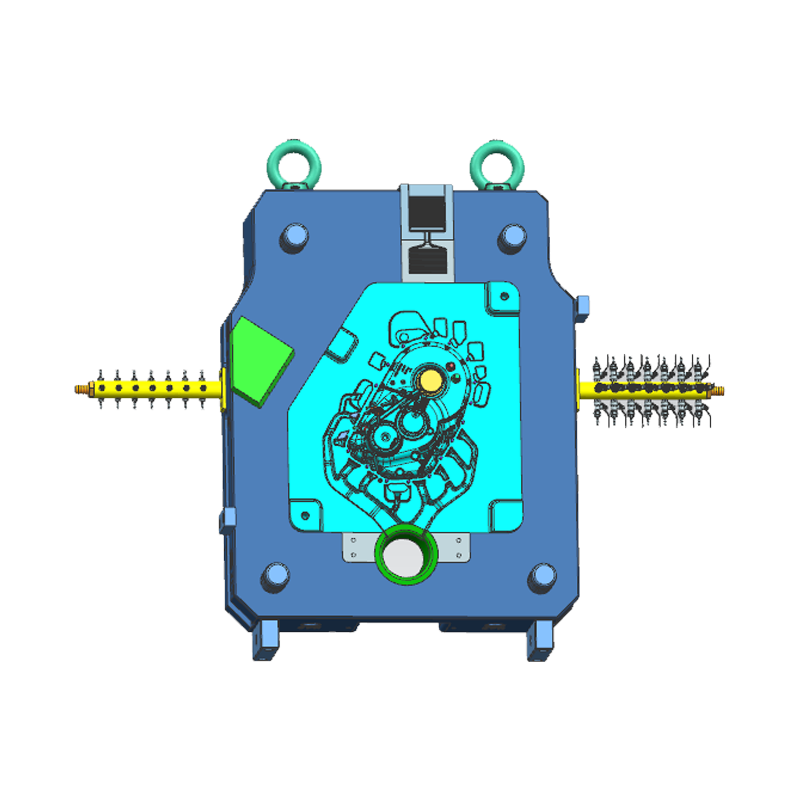
SERES transimission adopts complex cavity structure; high efficiency cooling system, the development...
Copyright © Ningbo Yunmai Precision Machinery Co., Ltd. All Rights Reserved
 OEM/ODM Die Casting/Cast Molds Manufacturers